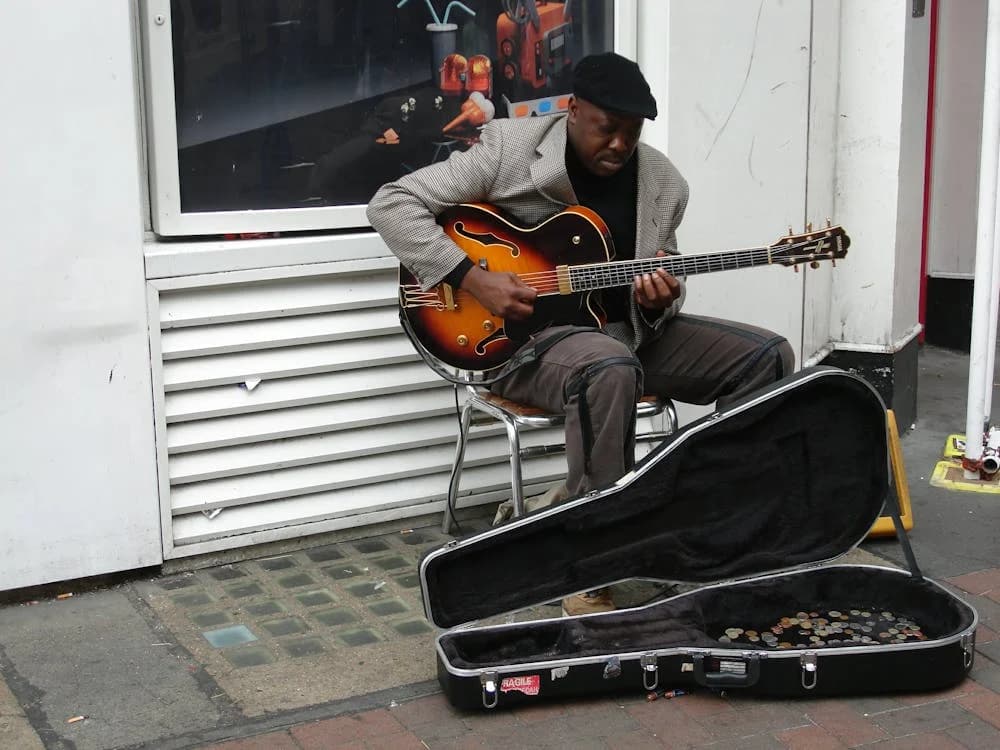
Musicians in 2026 earn money from streaming royalties, live performances, merch, sync licensing, teaching, session work, and fan subscriptions. Most independent artists combine 3-5 of these streams. Here is every revenue source available to you, ranked by accessibility.
Quick Reference: All Income Streams
| Revenue Stream | Difficulty to Start | Time to First Dollar | Income Potential |
|---|---|---|---|
| Streaming royalties | Easy | 2-3 months | Low per stream, scales with audience |
| Live performances | Easy | 1-2 weeks | $100 to $10,000+ per show |
| Merchandise | Easy | 2-4 weeks | High margins (70-80%) |
| Teaching | Easy | 1-2 weeks | $30 to $100+/hour |
| Session work | Medium | 2-4 weeks | $100 to $500 per session |
| Publishing royalties | Medium | 3-6 months | Passive, grows with catalog |
| Sync licensing | Hard | 3-12 months | $5,000 to $50,000+ per placement |
| Fan subscriptions | Medium | 1-2 months | Recurring monthly revenue |
| YouTube ad revenue | Medium | 3-6 months | $100 to $500+/month at scale |
| Brand partnerships | Hard | 6-12 months | $200 to $5,000+ per post |
| AI music licensing | Medium | 1-3 months | Emerging, modest but growing |
What You Will Learn
- Every major revenue stream available to musicians in 2026
- How streaming royalties actually work and how to maximize them
- Publishing income and why most artists leave money on the table
- Sync licensing opportunities and how to get placements
- Live performance revenue from local gigs to touring
- Merchandise and direct-to-fan sales strategies
- Teaching, session work, and other professional income streams
- New 2026 income streams: AI music licensing, Discord Server Subscriptions, YouTube Shopping affiliate
- How to build a diversified income that does not depend on any single source
Streaming Revenue
Streaming is the largest source of recorded music revenue globally. Spotify alone paid the music industry more than $11 billion in 2025, bringing its lifetime total to nearly $70 billion. Roughly half of those royalties went to independent artists and labels, according to Spotify's 2025 Loud and Clear report. Understanding how streaming payments work is essential for every musician.
We collected real payout data from distributors covering over 63 million streams across 70 platforms using a 12-month rolling window. The rates below are what artists actually earned, not estimates or marketing claims.
How Streaming Payments Work
Streaming platforms do not pay a fixed rate per stream. Instead, they use a pro-rata payment model where your share of total streams determines your share of the platform's total royalty pool for a given period.
Actual per-stream rates by platform (calculated from real payout data):
| Platform | Per Stream | Per Million Streams |
|---|---|---|
| Qobuz Streaming | $0.01683 | $16,828 |
| Qobuz | $0.01295 | $12,953 |
| TIDAL | $0.00825 | $8,246 |
| YouTube Music | $0.00523 | $5,234 |
| SoundCloud | $0.00522 | $5,221 |
| Apple Music | $0.004619 | $4,619 |
| Deezer | $0.00283 | $2,834 |
| Spotify | $0.002761 | $2,761 |
| Pandora | $0.00236 | $2,364 |
| Amazon Music | $0.00086 | $856 |
| TikTok | $0.000003 | $3 |
Streaming Platforms: Pay Per Million Streams (2026 Real Data)
Data collected from distributor payout reports over a 12-month rolling window. Actual rates vary by territory, subscription tier, and distributor agreements. Spotify and Apple Music rates shown above update dynamically.
These rates fluctuate monthly based on total platform revenue, total streams, your listener's country, and whether the listener has a paid or free account. For a full breakdown across all 70 platforms we track, see our which streaming platforms pay the best guide.
Use our Streaming Royalty Calculator to estimate your earnings across all major platforms based on your actual stream counts.
Maximizing Streaming Revenue
- Release consistently: Artists who release new music every 4 to 8 weeks maintain stronger algorithmic placement than those who release once or twice a year. Each release triggers Release Radar, algorithmic recommendations, and editorial consideration
- Optimize your profiles: Claim and optimize your Spotify for Artists and Apple Music for Artists profiles. Complete profiles receive more algorithmic promotion
- Pitch to playlists: Submit to editorial playlists through Spotify for Artists at least 3 to 4 weeks before each release. Target independent curators through SubmitHub (10% off with code t4m10off) and direct outreach
- Focus on saves and playlist adds: These engagement signals carry more weight than raw stream counts for algorithmic recommendations. Encourage fans to save songs and add them to personal playlists
- Distribute to every platform: Use a distributor like DistroKid (7% off), TuneCore, or CD Baby to ensure your music is available on every streaming platform, not just the major ones
The Revenue Reality
At Spotify's actual calculated rate of $0.002761 per stream ($2,761 per million streams), here is what different stream counts translate to in monthly revenue:
- 10,000 streams per month: approximately $28
- 50,000 streams per month: approximately $138
- 100,000 streams per month: approximately $276
- 500,000 streams per month: approximately $1,381
- 1,000,000 streams per month: approximately $2,761
These numbers illustrate why relying solely on streaming is difficult for most independent artists. Streaming works best as one component of a diversified income strategy. For a detailed breakdown of how streaming royalties are calculated, read our streaming royalty calculator guide.
Publishing Royalties
Publishing royalties are the income generated by your musical compositions (the songs themselves, as distinct from the recordings). For a detailed breakdown, read our complete Music Publishing Guide.
Types of Publishing Income
- Performance royalties: Generated when your song is played on radio, streamed, performed live, or broadcast on TV. Collected by your PRO (ASCAP, BMI, or SESAC in the US). Browse our PRO Directory to find the right organization
- Mechanical royalties: Generated when your song is reproduced (streamed, downloaded, or pressed onto physical media). Collected by the MLC (Mechanical Licensing Collective) in the US for streaming mechanicals, or by your publishing administrator
- Sync licensing fees: One-time payments when your song is placed in TV shows, films, commercials, video games, or other visual media. See our Sync Licensing Guide
The Publishing Gap
According to the Music Publishers Association, approximately $2.5 billion in publishing royalties go uncollected globally each year. The primary reason is that songwriters have not registered their works with the appropriate collection organizations.
If you are an independent artist who writes your own songs and have only set up distribution through DistroKid (7% off), TuneCore, or CD Baby, you are almost certainly missing your publishing royalties. Standard music distribution only collects master (recording) royalties. Publishing royalties require separate registration.
Minimum steps to collect your publishing income:
- Register with a PRO (ASCAP or BMI in the US)
- Register with the MLC for US streaming mechanical royalties
- Register each individual song with your PRO
- Consider a publishing administrator like Songtrust or TuneCore Publishing for worldwide collection
Use our Publishing Royalty Split Calculator to understand how co-writing splits affect your publishing income.
Sync Licensing
Sync licensing is one of the most lucrative and underutilized income streams for independent musicians. A single sync placement in a major TV show or commercial can pay $5,000 to $50,000+ as a one-time licensing fee, plus ongoing performance royalties every time the episode airs.
Where Sync Placements Happen
- Television: Reality shows, dramas, documentaries, and news programs use massive amounts of music. Reality TV alone drives thousands of sync placements per year
- Film: Feature films, independent films, and short films
- Commercials: National TV commercials pay the highest sync fees, often $50,000 to $500,000+ for well-known songs
- Video games: Background music, soundtracks, and in-game audio
- Trailers: Movie and TV trailers, video game trailers, and promotional content
- Social media: Branded content and advertisements
How to Get Sync Placements
- Sync licensing companies: These companies represent catalogs of music and actively pitch them to music supervisors. Explore companies in our Sync Licensing Directory
- Music libraries: Production music libraries license music for a range of media uses. Joining multiple libraries increases your chances of placement
- Direct outreach: Contact music supervisors directly with your catalog. Keep pitches brief, relevant, and professional
- Your publisher: If you have a publishing deal, your publisher should be actively pitching your music for sync opportunities
Making Your Music Sync-Ready
- Ensure you own or control 100% of both the master recording and the composition. Split ownership complicates licensing and can prevent placements
- Create clean (radio-edit) versions of any songs with explicit content
- Maintain organized metadata: song title, artist name, genre, mood, tempo, lyrics, and contact information
- Produce instrumental versions of every track. Many sync placements use instrumentals rather than vocal versions
Live Performance Income
Live performance remains one of the most direct and reliable income streams for musicians at every career level.
Revenue Sources from Live Performance
- Guarantee fees: The base payment you negotiate with the venue or promoter. For new artists, this might be $100 to $500 per show. For established independent artists, $1,000 to $10,000+
- Door splits: Instead of or in addition to a guarantee, you receive a percentage of ticket sales. Common splits are 80/20 or 70/30 in favor of the artist after expenses
- Merchandise sales: Live shows are the highest-converting environment for merch sales. Fans at shows buy merch at 5 to 10x the rate of online visitors
- Tips and donations: Particularly relevant for acoustic performers, street musicians, and musicians playing at restaurants and events
- Performance royalties: Your PRO collects performance royalties when your original songs are performed live. Make sure you report your setlists
Scaling Your Live Income
- Start local: Build a following in your home market before touring. A packed local venue proves demand and gives you leverage when booking in new cities
- Route efficiently: When touring, plan routes that minimize driving distance between shows. Every mile driven is a cost against your earnings
- Sell merch at every show: Have merchandise available at every performance. Even a simple table with t-shirts and vinyl records can double your per-show income
- Build relationships with venues: Repeat bookings at venues where you draw well are more reliable and profitable than constantly seeking new venues. Browse our Venues Directory for opportunities
- Apply to festivals: Music festivals offer exposure, guaranteed fees, and access to new audiences. Check our Music Festivals Directory for upcoming opportunities
Use our Tour Revenue Calculator to project your income and expenses for upcoming tours.
Merchandise and Direct-to-Fan Sales
Merchandise is one of the highest-margin income streams available to musicians. A t-shirt that costs $5 to $8 to produce can sell for $25 to $35, representing a 70% to 80% profit margin.
Merchandise Products
- Apparel: T-shirts, hoodies, hats, and accessories. T-shirts are the highest-volume merchandise item for most artists
- Physical music: Vinyl records, CDs, and cassettes. Vinyl sales have grown for 17 consecutive years as of 2024, with total US vinyl revenue exceeding $1.2 billion
- Digital products: Exclusive tracks, stems, sample packs, presets, and behind-the-scenes content
- Bundled packages: Combine physical products (signed vinyl + t-shirt + handwritten lyrics) for premium pricing
Selling Platforms
- Bandcamp: 85% of revenue goes to the artist (10% for Bandcamp Pro subscribers at $10/month). Bandcamp Fridays (specific dates throughout the year) waive the platform's share entirely. Excellent for building direct-to-fan relationships
- Shopify: Full e-commerce platform for building your own online store. More control and branding than third-party marketplaces
- Big Cartel: Simpler and cheaper than Shopify, designed specifically for artists and small businesses
- Your own website: Selling directly from your website eliminates all third-party fees and keeps the customer relationship entirely with you
Teaching and Session Work
Teaching Music
Private music lessons and online courses represent a stable, scalable income stream:
- Private lessons: $30 to $100+ per hour depending on your experience, location, and instrument. 10 students per week at $60/hour generates $2,400 per month
- Online courses: Create a course once and sell it repeatedly. Platforms like Skillshare, Udemy, and Teachable handle hosting and payment processing
- Group workshops: Teach 5 to 20 students simultaneously for a lower per-student rate but higher total revenue per session
- Masterclasses: Premium workshops on specialized topics (production techniques, vocal coaching, songwriting methods) can command $100 to $500+ per student
Session Musician Work
Playing or singing on other artists' recordings:
- Session rates: Union (AFM) scale starts at approximately $400 for a 3-hour recording session. Non-union rates vary widely but typically range from $100 to $500 per session
- Remote sessions: Record from your home studio and deliver files digitally. Platforms like SoundBetter and Fiverr connect session musicians with clients worldwide
- Residency gigs: Regular weekly or monthly performances at hotels, restaurants, or corporate events. These provide predictable income and are especially valuable for instrumentalists and vocalists
Content Creation and Brand Partnerships
Your music career generates content constantly: behind-the-scenes footage, recording sessions, gear walkthroughs, reaction videos, and the music itself. That content has monetary value beyond just streaming, and most artists are leaving it entirely on the table.
YouTube Ad Revenue
Once you qualify for the YouTube Partner Program (1,000 subscribers + 4,000 watch hours), your music videos, tutorials, and vlogs generate ad revenue. At 100,000 monthly views, expect $100 to $500 per month. See our YouTube Promotion Guide for growth strategies.
Brand Partnerships and Sponsorships
Brands in the music equipment, lifestyle, and technology spaces actively seek partnerships with musicians who have engaged audiences:
- Gear endorsements: Free or discounted equipment plus potential payment for featuring products in your content
- Sponsored content: $200 to $5,000+ per post depending on your audience size and engagement rate
- Affiliate marketing: Earn commission (typically 5% to 15%) on products you recommend to your audience through affiliate links
Patreon and Membership Platforms
Offer exclusive content to paying subscribers:
- Behind-the-scenes content, unreleased music, and early access to new releases
- Monthly pricing typically ranges from $3 to $25 per tier
- An artist with 200 patrons at an average of $8 per month earns $1,600 monthly in recurring revenue
- The key to Patreon success is delivering consistent exclusive value that fans cannot get elsewhere
New Income Streams for 2026
The music monetization landscape keeps evolving. These are revenue sources that have emerged or matured in 2026 that you should know about.
AI Music Licensing
AI companies need music to train their models, and some are now licensing music ethically from artists. LANDR's Fair Trade AI program lets you opt in to license your tracks for AI training and earn a 25% share of net licensing revenue, distributed based on your contribution. Over 30,000 artists have participated, and LANDR began issuing payouts in July 2026. You need to own 100% of both recording and publishing rights to participate.
Spotify and Universal Music Group also announced a fan-made covers and remixes tool in 2026, powered by generative AI. This creates a new revenue stream for participating artists and songwriters when fans create AI-driven covers of their songs. The tool launched as a paid add-on for Spotify Premium users, with royalties shared back to original rights holders.
The caveat: AI licensing revenue is still modest for most independent artists. Treat it as a supplementary income stream, not a primary one. Always read the terms carefully and make sure you retain ownership and control of your music.
Discord Server Subscriptions
If you have an engaged fan community on Discord, Server Subscriptions let you charge for premium access. You set the price (from $2.99 to $199.99 per month) and offer perks like exclusive channels, early access to releases, behind-the-scenes content, and subscriber-only streams. Discord takes a 10% platform fee, meaning you keep 90% of each subscription (minus payment processing fees).
Server Subscriptions are currently available to US-based server owners. For musicians with active Discord communities, this can generate meaningful recurring revenue from your most dedicated fans.
YouTube Shopping Affiliate
YouTube expanded its Shopping affiliate program in March 2026 to creators with 500 or more subscribers in the YouTube Partner Program. You can tag products from participating brands in your videos, Shorts, and Live streams and earn commission on qualifying purchases.
Important limitation: the YouTube Shopping affiliate program is not available for music channels, Official Artist Channels, or channels associated with music partners (labels, distributors, publishers, or VEVO). However, if you run a secondary channel focused on gear reviews, tutorials, or music production content (not classified as a music channel), you may be eligible to earn affiliate commissions by tagging music gear, software, and equipment.
TikTok SoundOn Distribution
TikTok's SoundOn distribution service has over 1.1 million registered artists. In February 2026, SoundOn overhauled its payout structure: artists now keep 100% of royalties on TikTok, CapCut, and other ByteDance platforms forever, plus 100% of third-party DSP royalties (Spotify, Apple Music, etc.) for the first 12 months after release, dropping to 90% thereafter. There is no annual fee and no recoupment. For artists whose audience discovery starts on TikTok, SoundOn can generate roughly 18 to 22% more net royalty per stream than a standard distributor plan, according to campaign data from over 2,400 campaigns.
Building a Diversified Income
The most financially resilient musicians do not depend on any single income stream. Here is how to think about building diversified music income at different career stages:
Early Career (0 to 1,000 monthly listeners)
- Primary focus: Building an audience through consistent releases and social media
- Active income streams: Teaching, session work, local live performances
- Passive income streams: Streaming royalties (small but growing), publishing registration
- Target monthly income from music: $500 to $2,000
Growth Stage (1,000 to 50,000 monthly listeners)
- Primary focus: Scaling audience through marketing, playlist pitching, and content creation
- Active income streams: Regional touring, merchandise at shows, teaching, session work
- Passive income streams: Growing streaming royalties, publishing income, YouTube ad revenue
- Target monthly income from music: $2,000 to $5,000
Established (50,000+ monthly listeners)
- Primary focus: Optimizing existing revenue streams and exploring new opportunities
- Active income streams: National/international touring, brand partnerships, premium merchandise
- Passive income streams: Significant streaming royalties, sync licensing placements, publishing income, Patreon/memberships
- Target monthly income from music: $5,000 to $20,000+
Frequently Asked Questions
Q: How much money do I need to start earning from music?
Very little upfront investment is required. A distributor like DistroKid (7% off) costs $24.99 per year for the Musician plan. Registering with a PRO is free. Building social media presence is free. The minimum viable investment to start earning from music is under $50. As your revenue grows, reinvest profits into better equipment, marketing, and professional services.
Q: How long does it take to earn a full-time income from music?
This varies enormously based on your genre, marketing effort, and definition of full-time income. Most independent artists who build sustainable music careers take 2 to 5 years of consistent effort to reach full-time income. Building multiple income streams simultaneously accelerates this timeline significantly.
Q: Should I quit my day job to focus on music?
Not until your music income consistently covers your living expenses for at least 6 months, or you have 12+ months of savings as a safety net. Many successful musicians maintain part-time employment (especially teaching or freelance work) while building their music career. There is no shame in having a day job. Financial stability actually gives you more creative freedom because you are not making desperate decisions out of financial pressure.
Q: What is the most profitable income stream for independent musicians?
It depends on your career stage and skills. For early-career artists, teaching and live performance typically generate the most reliable income. For growing artists, merchandise and direct-to-fan sales often have the highest margins. For established independent artists, sync licensing and touring tend to generate the largest paydays. The most profitable long-term strategy is building multiple streams simultaneously.
Q: Do I need a manager, agent, or lawyer?
Not at the very beginning. When you are earning under $1,000 per month from music, handle your own business. As your career grows and opportunities become more complex (label interest, sync placements, touring), invest in professional help. An entertainment lawyer ($200 to $500 per hour or 5% of deal value) is the first professional you should hire when contracts start appearing. A booking agent (10% to 15% commission) makes sense when your live show demand exceeds what you can book yourself. A manager (15% to 20% commission) makes sense when your career is complex enough that managing it takes significant time away from creating music.
Q: How do taxes work for musicians?
In the United States, music income is self-employment income. You are responsible for tracking all income and expenses, paying quarterly estimated taxes, and filing Schedule C with your annual tax return. Keep detailed records of all music-related expenses (equipment, travel, marketing, studio time, distributor fees) as these are deductible against your music income. Consult a tax professional familiar with entertainment industry taxation as your income grows.
Start Building Your Income Today
The path to earning a sustainable income from music is not complicated. It just requires doing the boring infrastructure work first: registering your publishing, claiming your profiles, setting up a distributor, and building at least one direct-to-fan channel before you need it. Most artists skip these steps because they seem administrative. Then they spend years leaving money on the table while wondering why streaming income never adds up.
Start this week. If you have released music and never registered with a PRO or the MLC, that is money sitting uncollected right now. Fix that first, then build from there. The artists earning real income from music are not luckier than you. They just did the unglamorous work earlier.
Next Steps:


