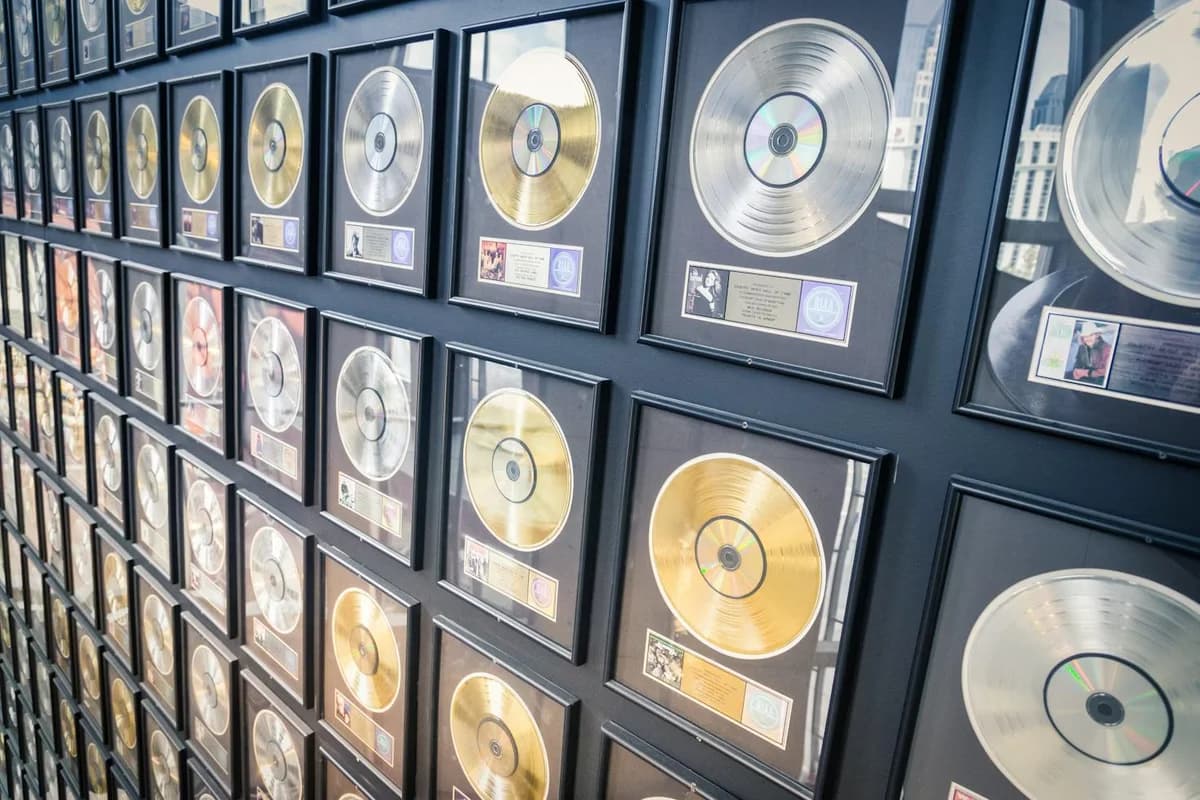
A platinum single in 2026 represents 150 million streams. A platinum album represents 1.5 billion streams. At Spotify's average payout of $0.002761 per stream, a platinum single generates roughly $2,761 times 150 in gross streaming revenue, while a platinum album generates about 10 times that. Some artists pocket millions. Others see less than $50,000 after recoupment. The plaque is the same. The contract is what makes the difference.
Most conversations about platinum records focus on the milestone itself and not the math behind it. This guide breaks down exactly what platinum means in 2026, how much artists actually earn in three realistic scenarios, and why two artists with identical streaming numbers can end up in completely different financial positions.
What You Will Learn
- What the RIAA platinum certification actually counts in 2026 (singles vs albums)
- How streaming revenue translates into real income at the platinum level
- Three scenarios: independent artist, major label deal, songwriter/feature
- Why publishing royalties can outpace master recording income
- The most common reasons platinum artists still end up broke
What Platinum Means in 2026: Singles vs Albums
The RIAA certifies platinum status based on units, not raw stream counts. But the conversion rate depends on whether you are certifying a single or an album. This distinction matters enormously and is the source of widespread confusion.
RIAA Digital Single Certification
For a single song, the RIAA uses a conversion rate of 150 on-demand streams per unit. One unit also equals one permanent digital download.
| Certification | Units Required | Streams Equivalent |
|---|---|---|
| Gold single | 500,000 | 75 million streams |
| Platinum single | 1,000,000 | 150 million streams |
| Diamond single | 10,000,000 | 1.5 billion streams |
RIAA Album Certification
For an album, the RIAA uses a conversion rate of 1,500 on-demand streams per unit. One unit also equals one album sale (physical or digital) or 10 individual track downloads from the album.
| Certification | Units Required | Streams Equivalent |
|---|---|---|
| Gold album | 500,000 | 750 million streams |
| Platinum album | 1,000,000 | 1.5 billion streams |
| Diamond album | 10,000,000 | 15 billion streams |
The certification is a marketing milestone. It tells you how many people consumed the music. It says nothing about how much money changed hands or who got it.
Spotify's 1,000-Stream Monetization Threshold
Since April 2024, Spotify requires a track to reach 1,000 streams in the previous 12 months before it generates any royalties. Tracks below this threshold generate zero revenue. Spotify estimates this policy redirects approximately $40 million per year to tracks that qualify.
This matters for platinum calculations because it means every stream counted toward platinum certification is also a monetized stream. There is no gap between the streams that count for certification and the streams that generate royalties on Spotify.
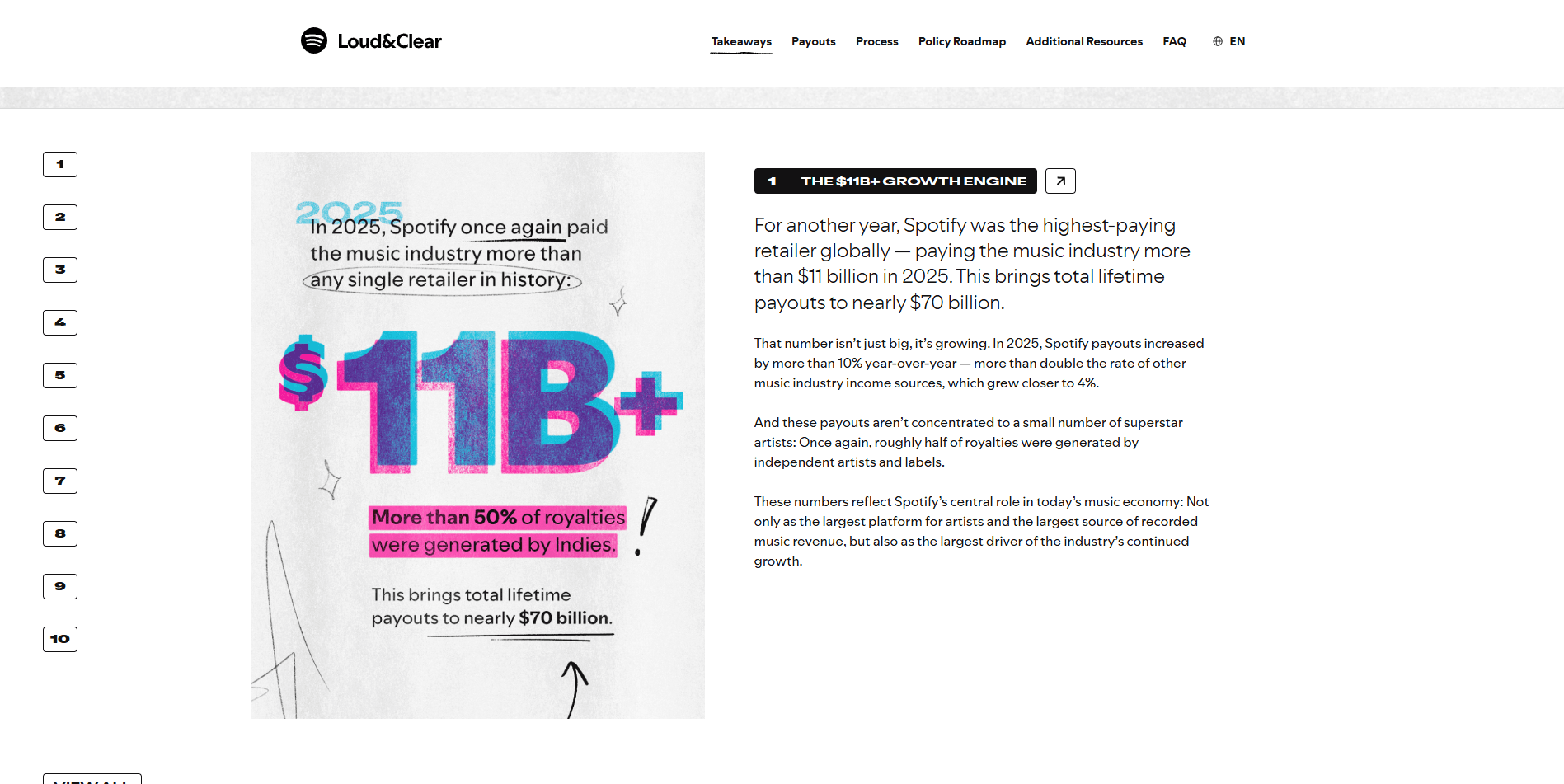
According to Spotify's Loud & Clear 2025 report, the platform paid over $11 billion to rights holders in 2025, bringing lifetime payouts to approximately $70 billion. More than 13,800 artists generated $100,000 or more in 2025, and approximately 3.5 million artists had at least one qualifying song. The average recording royalties per monetized song have roughly tripled since 2023, driven by Spotify Premium price increases (now $12.99/month in the US as of January 2026) and anti-fraud filtering that removes artificial streams from the royalty pool.
The Six Revenue Streams a Platinum Record Generates
Before getting into the scenarios, it helps to know where the money actually comes from when a song goes platinum. There are six distinct income streams, and most artists only see some of them directly.
1. Master recording royalties The income generated from streams and downloads on the recording itself. Who collects this depends on who owns the masters. If a label owns them, they collect and pay the artist a percentage. If the artist owns them, they collect through their distributor.
2. Mechanical royalties Paid for each reproduction of the composition. In the streaming era, interactive streaming services pay mechanical royalties to songwriters and publishers through the Mechanical Licensing Collective (MLC) in the US. The current statutory rate is $0.009909 per reproduction for permanent downloads and a formula-based rate for streaming.
3. Performance royalties Collected by PROs like ASCAP, BMI, SESAC, or GMR when a song is performed publicly, including on radio, TV, and in live venues. A platinum-selling track that receives significant radio airplay can generate six-figure performance royalty income on its own.
4. Sync licensing fees One-time fees paid when a song is licensed for use in film, TV, advertising, or video games. A platinum track has much higher leverage for sync deals than an unknown one. A single TV commercial placement can pay $25,000 to $250,000+ depending on the advertiser and territory.
5. Digital performance royalties via SoundExchange Non-interactive streaming services like Pandora and SiriusXM pay a separate performance royalty collected by SoundExchange. This is distinct from Spotify streaming income and goes directly to the master recording owner and the featured artist, split 45% and 45% respectively (10% goes to non-featured musicians).
6. Neighboring rights International performance royalties paid when master recordings are broadcast or performed publicly outside the US. Artists who fail to register for neighboring rights through a society like PPL (UK) or SCAPR-affiliated organizations leave real money uncollected. See our guide on neighboring rights and international royalties you may be missing for how to claim them.
Scenario 1: Independent Artist with Full Ownership
An independent artist who owns their masters and wrote the song entirely captures the full picture. Let us look at both a platinum single and a platinum album.
Platinum Single: 150 Million Streams
The numbers at 150 million streams:
- Gross streaming revenue (masters): approximately $2,761 times 150 (at $0.002761 per stream average)
- Distributor fee at 10%: subtract 10% from the gross
- Net master recording income: approximately 90% of the gross
Publishing income on top:
- Mechanical royalties: roughly $30,000 to $50,000 (depends on platform mix and country)
- Performance royalties (PRO income): $10,000 to $40,000+ if the track received significant radio airplay
- Total publishing estimate: $40,000 to $90,000
Realistic total for a platinum single: approximately $600,000 to $700,000 if the track received radio play. Without radio, the total is roughly $540,000 to $570,000 from streaming alone.
Platinum Album: 1.5 Billion Streams
The numbers at 1.5 billion streams:
- Gross streaming revenue (masters): approximately $2,761 times 1,500 (at $0.002761 per stream average)
- Distributor fee at 10%: subtract 10% from the gross
- Net master recording income: approximately 90% of the gross
Publishing income on top:
- Mechanical royalties: roughly $300,000 to $500,000 (depends on platform mix and country)
- Performance royalties (PRO income): $100,000 to $400,000+ if the tracks received significant radio airplay
- Total publishing estimate: $400,000 to $900,000
Realistic total for a platinum album: approximately $5.8M to $6.3M if the tracks received radio play. Without radio, the total drops to roughly $5.4M to $5.7M from streaming alone.
This is the best-case scenario. It requires owning 100% of your masters, writing 100% of the songs, using a distributor rather than a label, and being registered with all the right royalty collection bodies. Most artists are not in this position when they reach platinum. A lot of artists who release through distributors also do not have publishing administration set up, which means a significant portion of the publishing income goes uncollected. Our guide on all the music royalties you should be collecting covers the full checklist.
Scenario 2: Artist Signed to a Major Label
The math changes dramatically under a standard major label deal. Here is a realistic version using a platinum single (150 million streams) as the example:
Typical major label deal structure:
- Label owns the masters
- Artist royalty rate: 15% (range is 10% to 20% for new artists)
- Advance: $250,000 (must be recouped before royalties are paid)
- Recoupable costs include recording, mixing, mastering, marketing, music videos, and tour support. These costs are charged against the artist's royalty account, not the label's share.
The numbers at 150 million streams:
- Gross streaming revenue (masters): approximately $600,000 (at $0.002761 per stream average)
- Artist royalty at 15%: approximately $90,000
- Less: advance recoupment ($250,000)
- Less: recording and production costs ($150,000)
- Less: marketing and video costs ($200,000)
- Less: manager commission at 15% of gross royalties ($13,500)
- Less: attorney fees (roughly $5,000)
Artist net from master recording: $0 (still in recoupment)
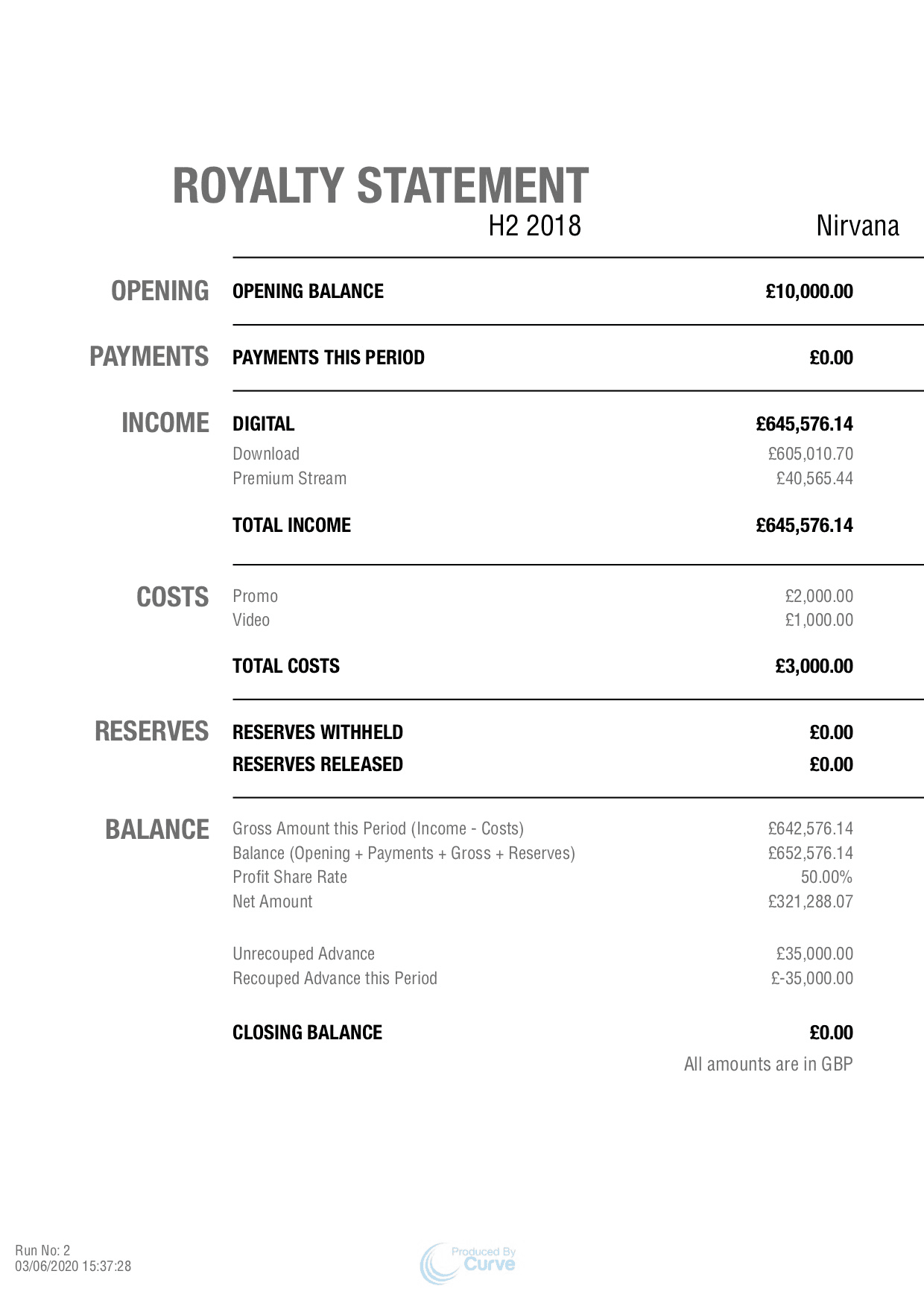
In this scenario, the artist has not yet recouped their advance and costs. The $90,000 in royalties is absorbed by the $250,000 advance alone, let alone the additional $350,000 in recoupable costs. The artist would need roughly 4x the streams (about 600 million) just to break even on a typical major label deal with this cost structure.
For a platinum album (1.5 billion streams), the numbers scale up proportionally:
- Gross streaming revenue: approximately $6,000,000
- Artist royalty at 15%: $900,000
- After recoupment of advance and costs ($600,000): $300,000
- After manager commission (15% of $900,000): $135,000
- After attorney fees: approximately $105,000
Artist net from a platinum album: approximately $105,000 to $135,000
That figure can go negative if the label spent aggressively on promotion. Many artists who receive platinum certifications while signed to major labels report earning very little from the certified record itself, particularly in the first few years when recoupment costs are still being deducted.
What the artist does keep directly:
- Their songwriter share of mechanical and performance royalties (if they wrote the song). Publishing income is separate from the master recording deal and generally not recoupable by the label, though 360-degree deals change this.
- SoundExchange's 45% featured artist share, which goes directly to the artist regardless of label deal.
Publishing can end up being the more valuable income stream for signed artists who write their own songs. For an in-depth look at how label deals work financially, see our guide on what record labels actually do.
Scenario 3: Songwriter or Featured Artist
Not all platinum contributors own a piece of the master. Songwriters and featured artists sit in a different financial position.
Songwriter with no ownership in the masters:
A co-writer who owns 50% of the publishing on a platinum single (150 million streams) earns:
- Mechanical royalties (50% of the writer's share): approximately $15,000 to $25,000
- Performance royalties via PRO (50% share): $5,000 to $20,000 depending on radio performance
Total songwriter income from a platinum single: roughly $20,000 to $45,000, assuming significant radio exposure. Without radio, the number is lower, around $15,000 to $25,000 from streaming mechanicals alone.
For a platinum album (1.5 billion streams), these figures scale up 10x:
- Total songwriter income: roughly $200,000 to $450,000 from a platinum album
Featured artist:
Featured artists typically receive a flat fee negotiated upfront rather than an ongoing royalty percentage. For an emerging artist featured on a song, the flat fee might be $2,000 to $10,000. For a well-known name, it can reach six figures. Once the flat fee is paid, the featured artist generally has no further claim on master or publishing income unless the contract specifically includes royalties.
The one exception is SoundExchange, which pays the featured artist directly for non-interactive streaming at 45% of the royalty regardless of other contractual arrangements.
Earnings Comparison by Artist Type
| Artist Type | Master Ownership | Platinum Single (150M streams) | Platinum Album (1.5B streams) | Publishing Income (album) |
|---|---|---|---|---|
| Independent (full ownership) | 100% | ~$540K-$570K | ~$5.4M | $400K-$900K |
| Major label (new artist, 15%) | 0% | $0 (in recoupment) | ~$105K-$135K after recoup | $200K-$450K (if songwriter) |
| Songwriter only (no masters) | 0% | $0 | $0 | $200K-$450K |
| Featured artist (flat fee) | 0% | Flat fee paid | Flat fee paid | $0 |
Estimates assume average Spotify rate of $0.002761 per stream, typical deal structures, and significant but not exceptional radio performance. Actual numbers vary based on country mix, deal terms, and royalty collection setup.
Why Platinum Artists Can Still End Up Broke
The gap between a platinum certification and financial stability is real, and it is not just a matter of bad luck.
Recoupment debt. A label artist who received a $500,000 advance and whose label spent $1.5 million on marketing needs $2 million in royalties to recoup before seeing a single check. A platinum album generating $900,000 in artist royalties still leaves the artist in debt by $1.1 million on paper. They can still earn publishing income, but the master recording income is entirely absorbed.
Royalty splits diluting income. A track written by five people, produced by a producer receiving points, and distributed through a label means the revenue is split many ways before any individual sees a significant check. Our music royalty splits guide breaks down how splits work in practice.
Not registered for all royalty streams. Many independent artists who own their masters and songs still fail to register with the MLC for mechanical royalties, their PRO for performance royalties, and SoundExchange for digital performance royalties. These royalties do not chase you down. You have to claim them.
No publishing administration. International mechanical and performance royalties from countries outside the US require a publishing administrator or sub-publisher to collect. Without this, significant income from streams in the UK, Germany, Japan, and other major markets goes uncollected or reverts to the platform after a holding period.
Lifestyle and management costs. A manager taking 15 to 20% of gross income, a booking agent at 10%, an attorney, a publicist, and a business manager add up quickly. On a $500,000 year, those costs can consume 40 to 50% of income before taxes.
For a practical setup that helps avoid these gaps, see our guide on how to track your music income and expenses.
Publishing Is Often Worth More Than the Master
This is the part most artists miss. Publishing income from a platinum track, particularly one that receives substantial radio airplay, can exceed the master recording income for a signed artist. And unlike the master recording income under a label deal, publishing income from a PRO goes directly to the songwriter, not through the label's recoupment system.
If you wrote the song and registered with ASCAP, BMI, SESAC, or GMR, every radio play, TV sync, and streaming mechanical generates money in your publishing account independently of whatever your label deal looks like. This is why experienced artists and their attorneys negotiate hard to keep publishing rights or at least maintain favorable terms in co-publishing arrangements.
For everything you need to know about how publishing works and what you should be collecting, see our complete guide to music publishing royalties.
Frequently Asked Questions
Q: How many streams does it take to go platinum?
A: It depends on whether you are certifying a single or an album. A platinum single requires 1 million units, and since the RIAA counts 150 streams per unit for singles, that equals 150 million streams. A platinum album also requires 1 million units, but uses 1,500 streams per unit, which equals 1.5 billion streams. The 10x difference is why it is critical to know which certification type you are discussing.
Q: Does a platinum record automatically mean the artist is rich?
A: No. A platinum single means the music reached 150 million streams. A platinum album means 1.5 billion streams. How much the artist earns depends entirely on whether they own the masters, how much was recouped under any label deal, and whether they are properly registered to collect all royalty streams.
Q: What is the difference between platinum and diamond?
A: Platinum certification requires 1 million units. Multi-platinum certifications cover 2 million, 3 million units, and so on. Diamond certification, the highest RIAA honor, requires 10 million units. A diamond single represents roughly 1.5 billion streams (10 million units times 150 streams per unit). A diamond album represents roughly 15 billion streams.
Q: If I go platinum independently, do I actually get to keep most of the revenue?
A: For a platinum single (150 million streams), gross streaming revenue at $0.002761 per stream average is roughly $2,761 times 150. After your distributor's fee and before taxes, an independent artist who owns 100% of their masters keeps approximately 90% of that. Add publishing and the number climbs. Taxes, manager fees, and other costs reduce it further. For a platinum album (1.5 billion streams), the numbers are 10x larger.
Q: How do I make sure I collect all the royalties from a platinum record?
A: Register your masters with your distributor. Register your compositions with your PRO (ASCAP, BMI, SESAC, or GMR). Register with SoundExchange for non-interactive digital performance royalties. Register with the MLC for US mechanical royalties. Set up publishing administration through a service like Songtrust or TuneCore Publishing for international royalties. Our guide on all the royalties you should be collecting has the complete checklist.
The Platinum Plaque Is the Beginning, Not the Payoff
Platinum status opens doors. It gives you leverage in licensing negotiations, booking, and brand partnerships. But the actual income from that milestone depends almost entirely on the legal and financial structure you had in place before the streams hit.
Own your masters if you can. Understand your deal before you sign it. Register for every royalty stream from day one, not after the numbers come in. And recognize that the songwriter share of publishing is often the most durable long-term income from any successful record.
Use our streaming royalty calculator to model what different stream counts generate across various ownership scenarios. And if you want to understand how your overall income as a musician should be structured, our complete guide to making money as a musician covers every revenue stream available to independent artists in 2026.
Next Steps:
- Check whether you are registered with ASCAP, BMI, SESAC, or GMR for performance royalties
- Register with the MLC if you distribute music to streaming platforms and have not already
- Register with SoundExchange for non-interactive streaming royalties
- Use our streaming royalty calculator to model your earnings at different stream milestones
External references: RIAA Certification Database, MLC Registration, SoundExchange Registration, Spotify Loud and Clear 2025.


