
When "Blurred Lines" generated over $16 million in royalties and then faced a copyright lawsuit, the legal battle took years and cost millions. When your indie track generates $40,000 from a sync placement and two collaborators disagree about the split, the outcome is equally destructive at your scale: a lawsuit, a lost friendship, or a disputed payment that neither party can collect while the dispute is unresolved.
The mechanics of royalty splits are not complicated. The problem is that most musicians never get comfortable talking about money during a creative session, so they leave it vague. Vague splits become problems when there is actual money involved.
This guide covers every type of royalty split in music, what the industry standards actually are, the specific agreements you need in writing, and how to handle disagreements before they escalate.
What You'll Learn
- The difference between publishing (composition) splits and master recording splits
- Industry standard rates for co-writers, producers, and featured artists
- How to handle producer points, upfront fees, and backend-only arrangements
- The specific documents you need and when to sign them
- How to calculate real dollar outcomes from different split scenarios
Quick Reference: Split Calculator Table
| Scenario | Publishing Split | Master Split | On $10,000 Master Royalties | On $10,000 Publishing Royalties |
|---|---|---|---|---|
| Solo writer, self-produced | 100% to you | 100% to you | $10,000 | $10,000 |
| 2 co-writers, equal split | 50% each | 50% each (if co-owned) | $5,000 each | $5,000 each |
| 3 co-writers, equal split | 33.3% each | 33.3% each (if co-owned) | $3,333 each | $3,333 each |
| 2 co-writers + producer (3 points) | 50% each | 47% each, 6% to producer | $4,700 each, $600 to producer | $5,000 each |
| Featured artist (10% of master) | 100% to main writer | 90% to main artist, 10% to feature | $9,000 to main, $1,000 to feature | $10,000 to writer |
| Producer only (work for hire, $500) | 100% to writer | 100% to artist | $10,000 to artist | $10,000 to writer |
Use our advanced royalty calculator to model your own split scenarios with real streaming numbers.
The Two Royalty Systems You Need to Understand
Every royalty in music flows from one of two separate copyrights, and the splits for each operate under different rules.
Composition copyright (publishing)
This covers the underlying song: the melody, chord structure, lyrics, and musical arrangement. It generates:
- Mechanical royalties (from streaming, downloads, and physical sales)
- Performance royalties (from radio, TV, live performances, and streaming)
- Sync licensing fees for the composition
The composition copyright is typically shared among co-writers. The split is expressed as percentages that total 100%.
Master recording copyright
This covers the specific recorded version of the song. It generates:
- Streaming master royalties (the amount your distributor pays you per stream)
- Sync licensing fees for the master recording
- Download royalties
Master ownership is typically held by the artists who recorded the track, and sometimes by producers who negotiated equity. Producer "points" come out of the master copyright.
Why this matters for splits: A producer who gets "3 points" on the master gets 3% of all master royalty income. A co-writer who gets "50% of publishing" gets 50% of all mechanical royalties, performance royalties, and sync composition fees. These are separate calculations from separate royalty pools.
Publishing Splits: How to Divide the Composition
The Default: Equal Splits
The most common approach to co-writing splits, particularly in pop, hip-hop, and EDM, is equal division regardless of contribution. Three writers in a room produce a song: each gets 33.33%. Four writers: each gets 25%.
Equal splits prevent arguments about who wrote more. They also prevent one collaborator from retroactively claiming they contributed more than others remember. For new collaborators who do not yet have a track record of trust, equal splits are generally the safest choice.
The downside: equal splits can feel unfair when one person wrote the hook and verse while another tweaked a chord voicing. This is where most split disputes originate.
Proportional Splits
Some collaborators prefer to negotiate splits based on actual contribution. A typical proportional breakdown might look like:
- Primary songwriter (wrote lyrics and main melody): 60%
- Producer (created the beat and wrote the chord progression): 30%
- Featured vocalist (ad-libbed and co-wrote the bridge): 10%
There is no industry standard formula for proportional splits. They are whatever the involved parties agree to. The most important thing is agreeing before the session is over, not six months later when you are trying to remember who wrote what.
The Melody vs. Lyrics Split
Some collaborations split the publishing 50/50 between the lyricist and the composer (the person who wrote the melody and chords). This is common in songwriter-composer partnerships where the roles are clearly delineated.
For most independent artists who do everything in the same room, this distinction is not useful and creates more confusion than clarity.
How Publishing Splits Affect Real Dollar Outcomes
Let's say a song gets 2 million streams on Spotify at $0.002761 per stream. That generates approximately $2,761 times 2, or roughly $7,800 in streaming royalties total.
The master rights owner receives approximately $7,800 (minus distributor fees).
The composition also generates mechanical royalties through the MLC (approximately $0.001 to $0.003 per stream in publishing revenue). On 2 million streams, the composition generates approximately $2,000 to $6,000 in additional mechanical royalties.
If two co-writers split the publishing 50/50, each receives $1,000 to $3,000 in mechanical royalties, in addition to their share of master royalties (if they co-own the master).
For comparison, the same 2 million streams on Apple Music at $0.004619 per stream would generate approximately $4,619 times 2 in master royalties, significantly more than Spotify. The publishing mechanical royalties would also be higher on Apple Music due to the higher per-stream rate.
Use our advanced royalty calculator to run your own split scenarios with real numbers across multiple platforms.
Master Recording Splits: Producer Points and Artist Shares
Producer Points
The standard approach for compensating producers on master recording income is "points." One point equals one percentage point of master royalty income. Producer points typically range from 1 to 5% for most independent and mid-tier productions, with higher percentages for established producers.
Standard producer point ranges:
- Staff producer, no prior credits: 1 to 3 points
- Independent producer with moderate credits: 3 to 5 points
- Established producer with strong credits: 5 to 8 points
- Major producer (DJ Mustard, Metro Boomin tier): 10 to 20+ points, typically negotiated deal-by-deal
On a track generating $10,000 in master royalties, a producer with 4 points receives $400. On a track generating $500,000 (a mainstream hit), that same 4 points is worth $20,000.
Important distinction: producer points come out of the master royalty only, not the publishing. A producer who gets 3 points on the master receives 3% of master royalty income. They do not receive any publishing royalties unless they also contributed to the composition (melody, lyrics, or chords) and negotiated a publishing split separately.
Upfront Fee vs. Points: The Negotiation
Producers and artists negotiate between three structures:
Upfront fee only (work-for-hire)
The producer is paid a flat fee ($200 to $10,000+ depending on credits and market) and receives no ongoing royalties. The artist retains 100% of the master. This is clean and simple. It is appropriate when the producer is early in their career, the track is experimental, or the artist wants to retain full control.
Upfront fee plus points
The most common professional arrangement. The producer receives a flat fee and a negotiated point structure on the master. This aligns incentives: the producer benefits when the track performs well, which motivates them to contribute their best work.
Points only (backend only)
The producer receives no upfront fee but takes a higher percentage of master royalties. This is appropriate when the artist cannot pay upfront and the producer believes in the project's potential. It is risky for the producer on tracks that do not perform but can be highly lucrative on breakout tracks.
Featured Artist Splits
Featured artist arrangements vary widely. The two most common structures are a flat fee or a percentage of master royalties (typically 5 to 15%).
Standard featured artist arrangements for master royalties:
- Flat fee (emerging featured artist): $200 to $2,000 one-time payment, no ongoing royalties. Simple and clean. The featured artist gets paid upfront and the main artist retains 100% of the master.
- Percentage deal (emerging featured artist): 5 to 15% of master royalties. The featured artist earns as the track earns.
- Established featured artist: 15 to 25% of master royalties
- Major featured artist (with bargaining power): 25 to 50% of master royalties, negotiated case by case
Featured artist arrangements usually also include publishing splits for any songwriting contribution the featured artist made to the composition. If the featured artist only performed on the track but did not write any part of it, they receive only master royalties (or a flat fee), not publishing royalties.
The Documents You Need
The Split Sheet
A split sheet is a simple document that records the publishing split for a specific song. It should include:
- Song title and date written
- Names and contact information of all contributors
- Each contributor's percentage of the composition copyright
- Each contributor's publishing administrator (PRO affiliation, publishing company name if any)
- Signatures of all parties
Split sheets do not need to be notarized or filed with any government agency. They are private agreements that document what everyone agreed to. In a dispute, a signed split sheet is evidence that overrides verbal claims.
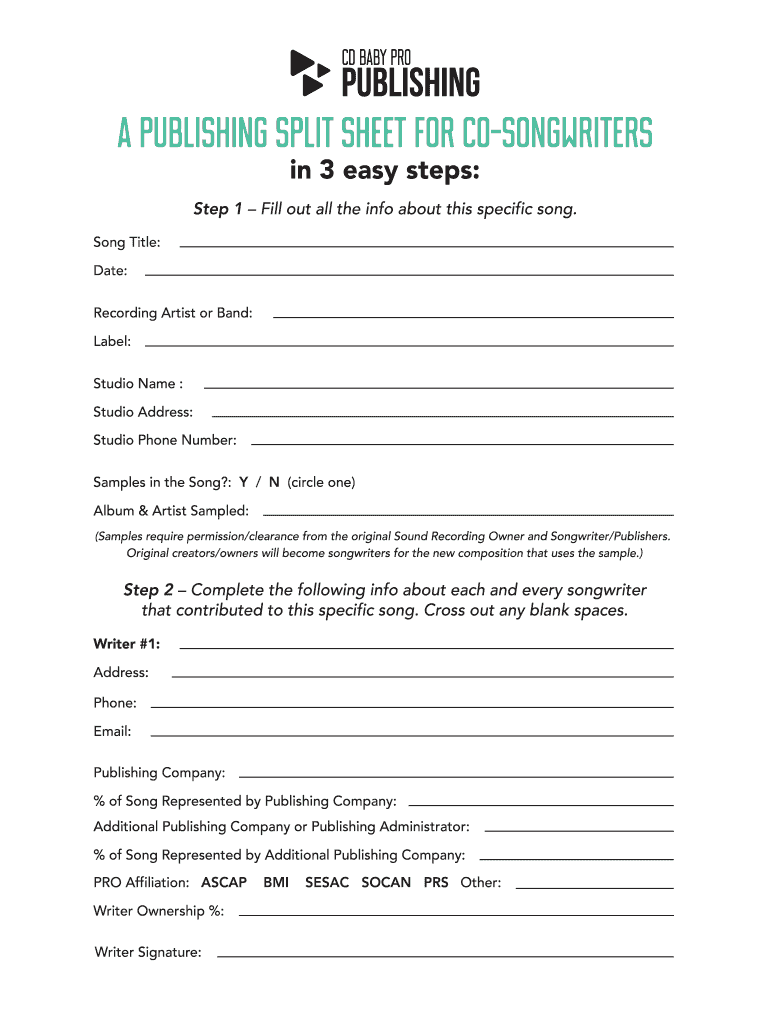
Sign the split sheet the same day you write the song. Waiting means memories will diverge.
You can generate a signed-ready split sheet in under a minute using our free royalty split sheet generator. Add collaborators, assign percentages, see live dollar amounts, and download a PDF on the spot.
The Producer Agreement
A producer agreement covers the master recording split and any production fees. It should include:
- Track name and recording date
- Upfront fee amount (if any) and payment terms
- Producer point percentage and the royalty base it applies to
- Whether points are "at source" (calculated from gross income) or "after recoupment" (not paid until the artist recoups advances and costs)
- Delivery requirements (what the producer is responsible for delivering)
- Credit requirements (how the producer should be credited on releases)
If you are working with an established producer, they will likely have their own standard agreement. Read it carefully before signing. If you are working with a newer producer, having a simple one-page producer agreement protects both parties.
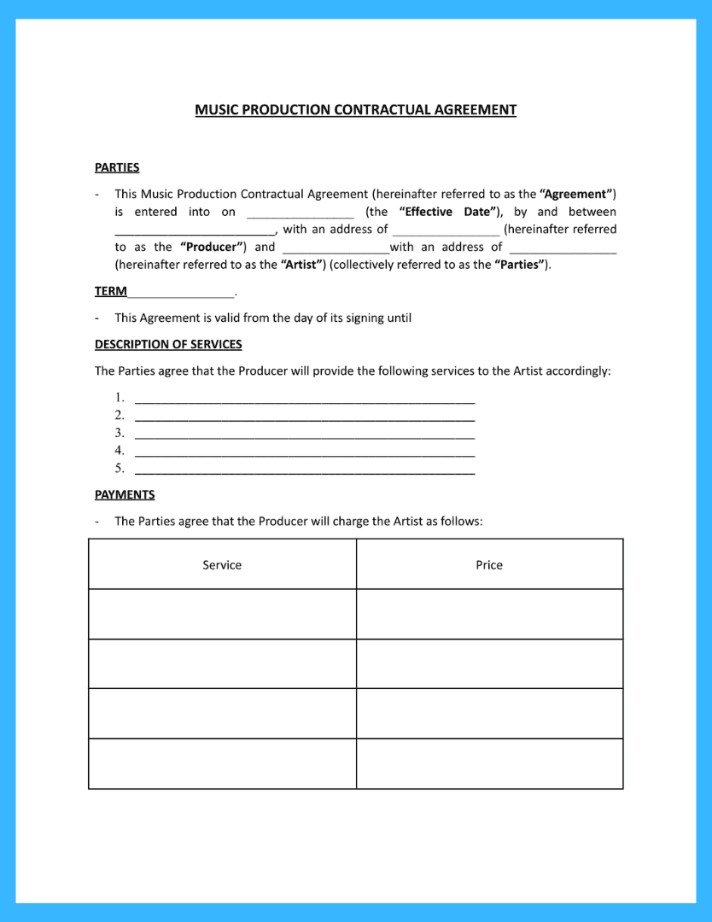
Our music contracts guide covers what to look for in any music agreement.
The Collaboration Agreement
For full bands and ongoing collaborative projects, a collaboration agreement documents ownership across the entire catalog. It should cover:
- How new songs are split (equal contribution, proportional, or case-by-case)
- What happens to catalog ownership if a member leaves
- Who controls decisions about sync licensing, cover song permissions, and catalog sales
- How touring income and merchandise are split
Many bands never sign these, which creates significant legal exposure if a member leaves or the band dissolves. See our music collaborations guide for templates and approach.
Split Sheet Tools and Automated Split Payments
In 2026, you no longer need to rely on paper split sheets and handshake agreements. Several digital tools make it easy to document splits, and some distributors now automate split payments so collaborators get paid directly.
Digital Split Sheet Tools
| Tool | Cost | Key Feature |
|---|---|---|
| SplitSheets.app | Free | Sign split sheets online in 60 seconds, no account required for signers |
| SongSplits | Free | Register splits from phone or desktop, all collaborators notified to sign off |
| Vandall | Free | Split sheet generator with auto-rebalancing, PDF export, audit trail with IP and timestamps |
| SplitWorx | Free (beta) | Full royalty split lifecycle from creation to contract generation, contributor approval via email |
All four tools let you create, sign, and store split sheets digitally. SongSplits and SplitSheets.app are the simplest for quick one-off splits. Vandall adds an audit trail with IP capture and timestamp per signature, which is useful if a dispute ever arises. SplitWorx is the most comprehensive, handling the full lifecycle from split creation to contract generation.
Automated Split Payment Features
DistroKid (7% off) Split Payments: DistroKid's Splits feature is free for all members with zero commission. You can automatically route any percentage of earnings from any track to collaborators like producers, bandmates, and managers. DistroKid pays them directly, so you do not have to handle manual bank transfers. You can edit splits and percentages at any time. If a collaborator does not have a DistroKid account, they get a 50% discount to sign up, or you can pay $10 per year for a "Split subscription" that lets them collect without a full DistroKid subscription. Students can use the DistroKid student plan (50% off).
SoundCloud Split Pay: For Artist Pro creators, SoundCloud's Split Pay tool lets you assign a percentage of a track's earnings to any collaborator using their SoundCloud Profile URL. You can set splits during the initial upload or at any time via the Split Pay tab in your dashboard. The process is fully automated, no manual transfers needed.
The "split before you release" rule: Set up your splits before you release the track, not after. If you wait until money starts coming in, you are already in dispute territory. Everyone remembers splits differently once there is money on the table. Document the split the same day you write the song, set up automated payments in your distributor before release, and you will never have a split dispute.
Sample Split Scenarios
Here are three common scenarios with real numbers to show how splits work in practice.
Scenario 1: Two Co-Writers, Equal Split
Two songwriters co-write a song in a single session. Both contribute equally to lyrics and melody. They split publishing 50/50. They co-own the master 50/50.
The song gets 1 million Spotify streams, generating approximately $2,761 in master royalties and approximately $1,000 to $3,000 in mechanical royalties through the MLC.
- Each co-writer receives approximately $2,761 divided by 2 in master royalties (minus distributor fees)
- Each co-writer receives $500 to $1,500 in mechanical royalties
- Total per co-writer: approximately $2,000 to $5,000
Scenario 2: Three Co-Writers Plus Producer (3 Points)
Three songwriters co-write a song with a producer who created the beat and chord progression. Publishing is split equally three ways (33.3% each). The producer negotiated 3 points on the master but did not contribute to the composition, so they get no publishing. The three co-writers co-own the master, with the producer's 3 points coming off the top.
The song gets 1 million Spotify streams, generating approximately $2,761 in master royalties.
- Producer receives 3% of master royalties: approximately $2,761 times 0.03
- Remaining 97% is split three ways: each co-writer gets approximately 32.3% of master royalties
- Each co-writer also receives 33.3% of mechanical royalties ($333 to $1,000 each)
Scenario 3: Main Artist with Featured Artist (10% of Master)
A main artist writes a song solo (100% publishing) and brings in a featured artist who performs a verse but does not contribute to songwriting. The featured artist negotiates 10% of master royalties.
The song gets 1 million Spotify streams, generating approximately $2,761 in master royalties.
- Featured artist receives 10% of master royalties: approximately $2,761 times 0.10
- Main artist receives 90% of master royalties: approximately $2,761 times 0.90
- Main artist receives 100% of publishing royalties ($1,000 to $3,000 in mechanicals)
- Featured artist receives $0 in publishing royalties (no songwriting contribution)
Mechanical vs. Performance Split Differences
One common source of confusion is that publishing splits apply differently to mechanical royalties and performance royalties, and the collection mechanisms differ.
Mechanical royalties are generated from streams, downloads, and physical sales. In the US, they are collected by the MLC (Mechanical Licensing Collective) and distributed to publishers and self-published songwriters based on the split percentages registered with the MLC. Internationally, mechanical societies like GEMA (Germany), SACEM (France), and JASRAC (Japan) handle collection.
Performance royalties are generated from radio play, TV, live performances, and streaming. They are collected by PROs (Performance Rights Organizations) like ASCAP, BMI, and SESAC in the US, PRS in the UK, GEMA in Germany, and SOCAN in Canada. Performance royalties are split between the songwriter share and the publisher share, typically 50/50 of the total performance royalty.
Why this matters for splits: If two co-writers split publishing 50/50, they each get 50% of mechanical royalties and 50% of performance royalties. But the registration process is different for each. You must register the split with both the MLC (for mechanicals) and your PRO (for performance royalties). Registering with only one means you are leaving money on the table.
See our PRO comparison guide for details on how each PRO handles split registrations.
International Royalty Collection Splits
If your music is streamed globally, your publishing royalties are collected by different societies in different countries. The split percentages you agreed to do not change, but the collection process does.
| Country | Mechanical Society | Performance Society |
|---|---|---|
| United States | MLC | ASCAP, BMI, SESAC, GMR |
| United Kingdom | PRS/MCPS | PRS |
| Germany | GEMA | GEMA |
| France | SACEM | SACEM |
| Canada | CMRRA | SOCAN |
| Japan | JASRAC/NexTone | JASRAC/NexTone |
| Australia | AMCOS | APRA |
If you are self-published, you need to register your splits with each society directly, or use a publishing administrator like Songtrust or CD Baby Pro that handles global registration for a percentage fee. Without proper international registration, your international royalties go uncollected and eventually escheat to the societies.
How to Handle Disagreements About Splits
Before a Dispute Escalates
The moment you feel that a split discussion is becoming uncomfortable, that is the moment to get everything in writing. Do not let the session end on a vague verbal agreement. A 30-minute conversation to document the split is infinitely preferable to a legal dispute 18 months later.
If you and a collaborator genuinely cannot agree on splits, consider:
- Going back to an equal split and moving forward
- Having each party state their contribution in writing so there is a shared record
- Bringing in a neutral third party (a manager, a music attorney, or another trusted collaborator) to mediate
When a Dispute Has Already Happened
Once there is a dispute over splits, the options depend on what documentation exists:
Signed split sheet exists: Your position is documented. Consult a music attorney about enforcement.
No documentation, both parties remember differently: This is the worst position to be in. Without documentation, resolution may require negotiation or, in extreme cases, litigation. Neither is cheap.
Registered with a PRO but split is wrong: Contact your PRO directly. Both ASCAP and BMI have processes for resolving registration disputes, though they can take months to resolve.
Prevention is the only real solution. Sign the split sheet the same day you write the song.
Frequently Asked Questions
Q: Can split percentages be changed after a song is released?
A: Yes, but it requires agreement from all parties and updates to all registrations (PRO, MLC, and any relevant distributor metadata). This process can take months and is significantly more complicated than getting the split right before release. Get it right the first time.
Q: Do producers automatically get publishing royalties?
A: Not automatically. If a producer contributes original melodic or harmonic elements to the composition (not just the beat), they may be entitled to a publishing split. If they only produced the instrumental track without contributing to the song's composition, they typically receive only master royalties (points). This distinction should be clarified and documented during the session.
Q: What happens to royalty splits if a collaborator passes away?
A: Royalty rights pass to the deceased person's estate and eventually to their heirs or beneficiaries. This is why clear split documentation is important: unclear splits can create legal complications for estates. All split agreements should have clear documentation of who holds which rights.
Q: Should I use a music lawyer for a split agreement?
A: For a standard co-write with someone you know and trust, a split sheet you both sign is sufficient. For high-value productions, placements worth significant money, or deals with established industry professionals, having a music attorney review any agreement before you sign is worth the cost. An hour of legal consultation costs $150 to $400. A dispute in court costs $10,000+.
Q: Can a producer demand publishing rights in addition to master points?
A: Yes, and some do. Top producers sometimes negotiate for a percentage of publishing royalties in addition to their master points, particularly if they contribute melodic or harmonic elements to the composition. This is negotiable. If a producer asks for publishing rights but did not contribute to the composition, you can decline or offer a smaller percentage. If they did contribute creatively to the song's melody or lyrics, their claim to publishing is legitimate.
Get the Agreement Before You Need It
The time to discuss splits is at the beginning of a collaboration, not when something valuable is at stake. Most split disputes happen because two people who like each other did not want to talk about money and assumed they were on the same page.
Use a split sheet template for every session. Make it a habit, not a special occasion. The five minutes it takes to document and sign the agreement is the cheapest music business insurance you will ever buy.
Our free royalty split sheet generator lets you build a signed-ready split sheet in under a minute, with live dollar amounts per collaborator and a downloadable PDF. Our advanced royalty calculator lets you model different split scenarios to see how percentage differences translate to real dollar outcomes at different streaming levels.
Next Steps:


