
Music technology companies need people who understand the moment a creator loses trust in a tool. You know what latency feels like during a take, why a buried export setting ruins a deadline, and why musicians resist a technically correct feature that interrupts flow.
That domain knowledge can help you enter product support, customer success, community, operations, marketing, partnerships, UX research, data, quality assurance, or product management. It does not automatically qualify you to write production audio code. Match the entry route to the evidence you have.
This guide compares roles, translates music work into employer language, and lays out a 12 to 24-month transition without pretending a short course guarantees a job.
What You Will Learn
- Which music tech roles fit different backgrounds
- What transfers from artist and production work
- How much technical literacy each path requires
- How to build portfolio proof without a tech job
- How to rewrite a music resume
- How to network without asking strangers for jobs
- How to keep music beside a tech career
Understand the Sector
Music tech includes streaming, creator tools, DAWs, plugins, notation, education, ticketing, rights, royalties, analytics, live systems, collaboration, audio hardware, games, and machine-learning products.
The Audio Developer Conference maintains a specialist jobs board that shows the depth of engineering roles across audio companies. Berklee's music business career directory shows non-engineering routes around products and rights.
Do not target "Spotify" or "Ableton" as a career plan. Target a role, capability, company stage, and user problem. Twenty smaller firms may offer a better first step than one famous platform.
Compare Music Tech Career Paths
| Role | Music advantage | Additional proof needed | Coding level |
|---|---|---|---|
| Customer support or success | Workflow knowledge and empathy | Clear troubleshooting and documentation | Low |
| Community or marketing | Audience and creator communication | Campaigns, writing, analytics | Low |
| Operations or program management | Releases, tours, vendors, deadlines | Process maps, budgets, results | Low |
| Partnerships or sales | Industry network and needs | Pipeline, negotiation, revenue outcomes | Low |
| UX research or design | Creator empathy | Research cases, prototypes, accessibility | Low to medium |
| Product management | User and market judgment | Prioritization, specs, shipped projects | Medium literacy |
| Data analysis | Catalog and audience context | SQL, spreadsheets, dashboards, statistics | Medium |
| QA or audio testing | Critical listening and reproducibility | Test plans, bug reports, platform knowledge | Medium |
| Audio software engineering | DSP and production knowledge | Strong coding, math, systems, shipped software | High |
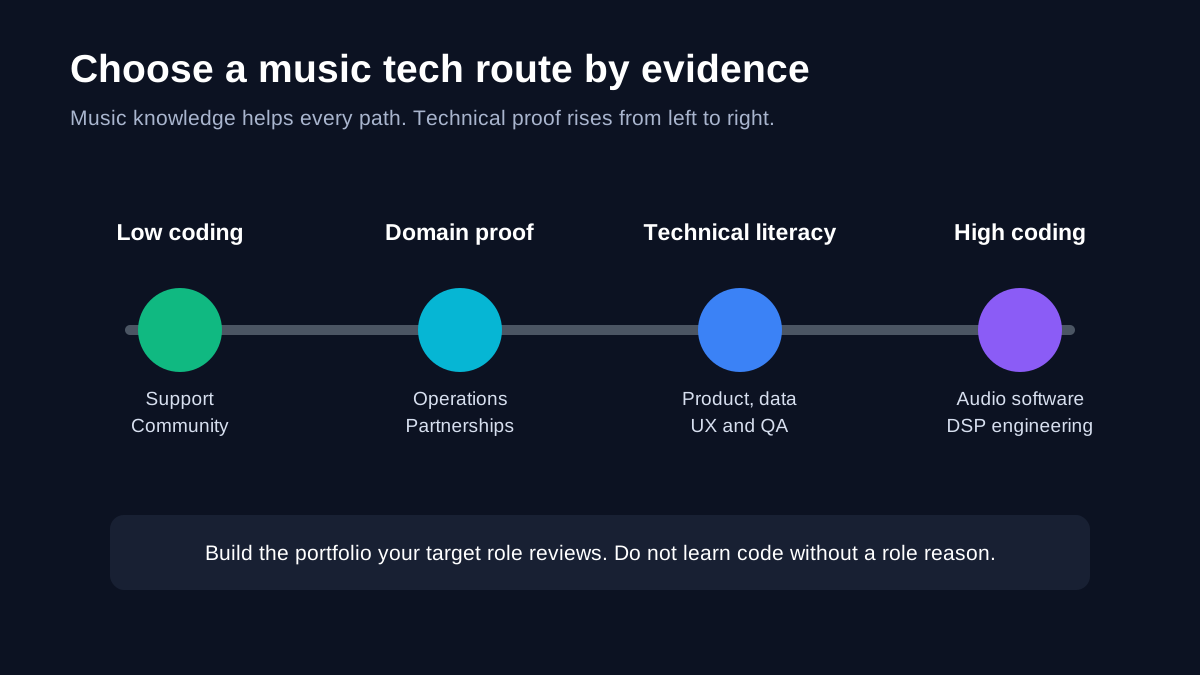
US BLS data says computer and information technology occupations had a median annual wage of $109,470 in May 2025, compared with $50,980 for all occupations. That group contains many jobs and is not a promise for a music tech applicant. See the BLS computer and IT overview.
BLS reports median 2025 pay of $135,980 for software developers and $104,300 for software QA analysts and testers. Those occupations usually require substantial technical preparation. Read the official software occupation profile before using those figures.
Translate Music Experience Into Work Outcomes
Replace insider shorthand with scope, action, and result.
| Music experience | Employer-friendly version |
|---|---|
| Produced an album | Led a multi-stage product from concept to delivery across creative and technical contributors |
| Managed a tour | Coordinated a multi-market schedule, vendors, travel, budget, and live delivery under fixed dates |
| Ran fan community | Built and moderated an audience program, resolved issues, and measured engagement |
| Mixed client tracks | Diagnosed technical and creative problems, managed revisions, and delivered quality-controlled files |
| Released independently | Managed rights, metadata, distribution, creative assets, marketing, and reporting |
| Taught production | Explained complex workflows to users with different skill levels |
Add real numbers you can defend: budget, number of releases, cities, collaborators, support cases, turnaround, conversion, or error reduction. Do not invent growth or claim company revenue from a stream estimate.
Use transferable music skills for more examples and moving from artist to executive if product work is not your best fit.
Build Technical Literacy for the Role
For support and customer success
Learn structured troubleshooting, ticket writing, screen recording, knowledge-base design, privacy, accessibility, and escalation. Practice reproducing a DAW or distributor issue from clean steps.
For product and operations
Learn user stories, requirements, prioritization, roadmaps, experiments, analytics, APIs, databases, and software release cycles. Technical literacy helps you collaborate. It does not require pretending to be an engineer.
For data
Learn spreadsheets, SQL, descriptive statistics, chart design, and data limitations. Build a dashboard from a public or personal dataset you have permission to use.
For engineering
Learn a general language plus the stack used by target roles. Audio development may require C++, DSP math, real-time systems, plugin formats, testing, and platform tooling. Python or JavaScript alone does not make you an audio engineer.
Avoid courses that guarantee employment. Before paying, check completion data, refund terms, instructor work, curriculum age, and whether the portfolio matches real job descriptions.
Build a Small Proof Portfolio
Choose two or three role-specific projects.
Support project: write a help article and troubleshooting tree for a real music workflow. Include expected behavior, reproduction steps, screenshots, privacy notes, and escalation criteria.
Product project: interview five musicians about one narrow problem, synthesize findings, propose options, define success, and build a simple prototype. Do not call a redesign validated after asking only friends.
Operations project: map an independent release from audio delivery to royalty review. Identify owners, inputs, failure points, and controls.
Data project: analyze your own release or public data and state what cannot be inferred. Show clean methods, not a dramatic chart.
Engineering project: ship a small audio tool with tests and documentation. A working gain utility or MIDI tool is stronger than a grand unfinished DAW.
Publish only data and materials you own. Remove client sessions, private fan information, keys, and confidential metrics.
Target Companies by Problem
Create categories:
- Creator and recording tools
- Distribution, rights, and royalty systems
- Streaming and audience products
- Music education
- Live, ticketing, and venue products
- Audio hardware and embedded systems
- Music data and analytics
- Games, film, podcast, and immersive audio
Then record product, user, open roles, required proof, location rules, salary range, and one informed contact. Do not apply to 100 unrelated jobs with the same resume.
Use products deeply before interviews. Prepare one thoughtful strength, one user problem, and one tradeoff. Never arrive with a list of insulting "easy fixes" based on incomplete information.
Network as Research First
Ask a person about role reality, not for a referral in the first message.
A useful request:
I am a producer moving toward customer success for creator tools. I saw that you moved from studio work into support. Could I ask three questions about the proof hiring teams valued? I will keep it to 20 minutes.
Respect a no or silence. After a conversation, apply the advice and report one useful result. That creates a relationship better than repeated asks.
Attend product meetups, audio developer events, music-business conferences, and online communities only when the role and users fit. Follow company engineering blogs, release notes, support docs, and product updates.
Use a 12 to 24-Month Plan
| Phase | Timing | Output |
|---|---|---|
| Select | Months 1 to 2 | One target role and 20-company list |
| Learn | Months 2 to 6 | Core technical literacy and one project |
| Prove | Months 5 to 9 | Two more portfolio cases and feedback |
| Apply | Months 8 to 18 | Tailored applications and interview practice |
| Adapt | Months 12 to 24 | First role, contract, apprenticeship, or revised path |
Timelines depend on market, location, prior skills, visa status, and role. Keep income while building proof. A second career alongside music can be the destination, not merely a bridge.
Evaluate Compensation Beyond Salary
Compare base pay, bonus, equity, health coverage, retirement, paid leave, remote rules, equipment, travel, layoffs, intellectual-property terms, and outside-work policies.
Read the employment agreement before assuming you can release music, sell plugins, or freelance. Ask how outside creative work and inventions are treated. Get legal advice if ownership language is broad.
A tech salary can fund music, but a demanding on-call or startup role can consume the energy music needs. Interview the job as carefully as the company interviews you.
Run a Better Application Process
Treat applications as product iterations, not a volume contest.
- Select a role family. Use one primary target for eight weeks, such as creator-tool customer success or audio QA.
- Build a requirement matrix. Collect 20 postings and count recurring tools, problems, outcomes, location rules, and seniority.
- Create two resume versions. Tailor evidence for the role family and company problem without rewriting your identity for every listing.
- Prepare three cases. One success, one failure, and one ambiguous decision should show scope, action, result, and lesson.
- Track the funnel. Record applications, recruiter calls, hiring-manager calls, exercises, final rounds, rejections, and feedback.
- Change one variable. If no screens occur after 20 well-matched applications, review targeting and resume. If screens do not reach final rounds, practice role examples and technical depth.
Do not publish private recruiter messages or interview exercises. Follow instructions about confidentiality and generated assistance. If an employer prohibits AI use in an assessment, respect the rule.
Research the product before each interview. Complete a real workflow, read release notes and support documentation, and note one tradeoff. A useful product observation includes the user, context, cost, and missing information. "The interface is bad" shows neither empathy nor product judgment.
Ask about on-call work, data access, creator safety, accessibility, model training, licensing, moderation, layoffs, and how user feedback reaches decisions. Music tech can combine artistic purpose with the same business and labor risks as other technology sectors.
Your Next 30 Days
In week one, select one role family and collect 20 postings. In week two, translate three music projects into cases that match recurring requirements. In week three, build one small artifact: support guide, test plan, user interview summary, data analysis, process map, or working audio utility. In week four, ask two people in the field to review the proof rather than your ambition.
Record what changed after feedback. A music tech transition becomes credible when you can point to improved work, not when you add another broad course badge. Apply to a small number of well-matched openings only after the evidence pack can answer why this role, why this product, and why you now.
Related Resources
- Build a second career alongside music
- Move from performing into production
- Understand multiple musician income streams
- Plan a career pivot deliberately
- Protect mental health during a career change
Frequently Asked Questions
Q: Do I need to code for music tech?
A: Not for every role. Support, operations, marketing, community, partnerships, and some product roles value domain knowledge and technical literacy. Engineering requires real coding evidence.
Q: Is a bootcamp enough?
A: A bootcamp may provide structure, but it does not guarantee work. Review real postings and build proof that matches them before enrolling.
Q: Should I hide my artist career?
A: No. Translate it into outcomes and explain conflicts or schedule clearly. Music experience is useful when it supports the role, but the employer still needs relevant proof.
Q: Can I enter at a mid-level title?
A: Sometimes, if your previous work demonstrates equivalent scope. Domain expertise alone rarely replaces management, product, or engineering experience. Coordinator or specialist roles can be strategic entries.
Q: Which portfolio project is best?
A: The one that mirrors the target job and reaches a finished, reviewable result. A support applicant should show troubleshooting, not a generic app mockup.
Q: Can I keep touring?
A: Maybe. Confirm leave, remote, travel, outside-work, and conflict policies before accepting. A flexible contract or smaller company may fit better than a strict role.
Translate One Project Today
Take your last release, tour, session, or teaching program. Rewrite it as a five-line case with problem, scope, action, result, and lesson. Match each line to one real music tech job description.


