
Talent does not turn a hobby into a profession. Repeated delivery does. A professional musician finishes work on schedule, answers messages, tracks money, serves audiences and clients, and keeps creating when inspiration is absent.
The financial gap is just as important. The US Bureau of Labor Statistics reports that 48 percent of musicians and singers are self-employed. It also reports a median hourly wage of $47.80 for paid work in May 2025, but many musicians work intermittently and are not paid for practice, travel, promotion, or administration. An hourly figure is not a stable monthly salary.
The IFPI Global Music Report 2026 says recorded music revenue grew 6.4 percent worldwide in 2025, with subscription streaming accounting for 69.6 percent of revenue. That is industry revenue, not a typical musician's pay. Use it as market context, not as a reason to expect your own income to rise.
That is why quitting a job after one strong month is dangerous. You need evidence that music income can cover your real costs, taxes, quiet months, health needs, and reinvestment. This guide gives you the numbers and a three-phase transition instead of a motivational leap.
What You Will Learn
- The practical difference between hobby and professional behavior
- How to calculate survival and sustainability targets
- Why revenue diversity matters
- How to test full-time music while still employed
- How much runway to build
- A three-phase transition plan
- How to structure the first months without a boss
Make the Mindset Shift Visible
Calling yourself professional is less useful than changing what you do each week. Professional behavior includes:
- Keeping a calendar for rehearsals, releases, sessions, invoices, and follow-ups
- Delivering the agreed work in the correct format on time
- Separating business and personal money
- Using contracts and written confirmations
- Maintaining instruments, files, backups, and insurance
- Practicing for the job you accepted, not only the music you enjoy
- Reviewing income, expenses, audience data, and pipeline every month
A hobby can remain serious and meaningful. You do not need to monetize music to validate it. Make this transition only if you want the obligations that accompany paid work.
The BLS musicians and singers profile notes that schedules are often irregular and include nights and weekends. It projects little overall employment change from 2025 to 2035. Your plan should not depend on one employer creating a conventional full-time role.
Calculate Survival Before Sustainability
Your survival threshold is the amount needed to cover basic personal and business obligations. Your sustainability threshold adds the costs that let you stay healthy and continue working.
Use this monthly template:
| Cost | Survival | Sustainable |
|---|---|---|
| Housing and utilities | $1,500 | $1,500 |
| Food and transport | $750 | $900 |
| Health and insurance | $350 | $500 |
| Minimum debt and family costs | $400 | $400 |
| Music operating costs | $250 | $600 |
| Tax reserve | $0 | $1,000 |
| Emergency and retirement saving | $0 | $600 |
| Total | $3,250 | $5,500 |
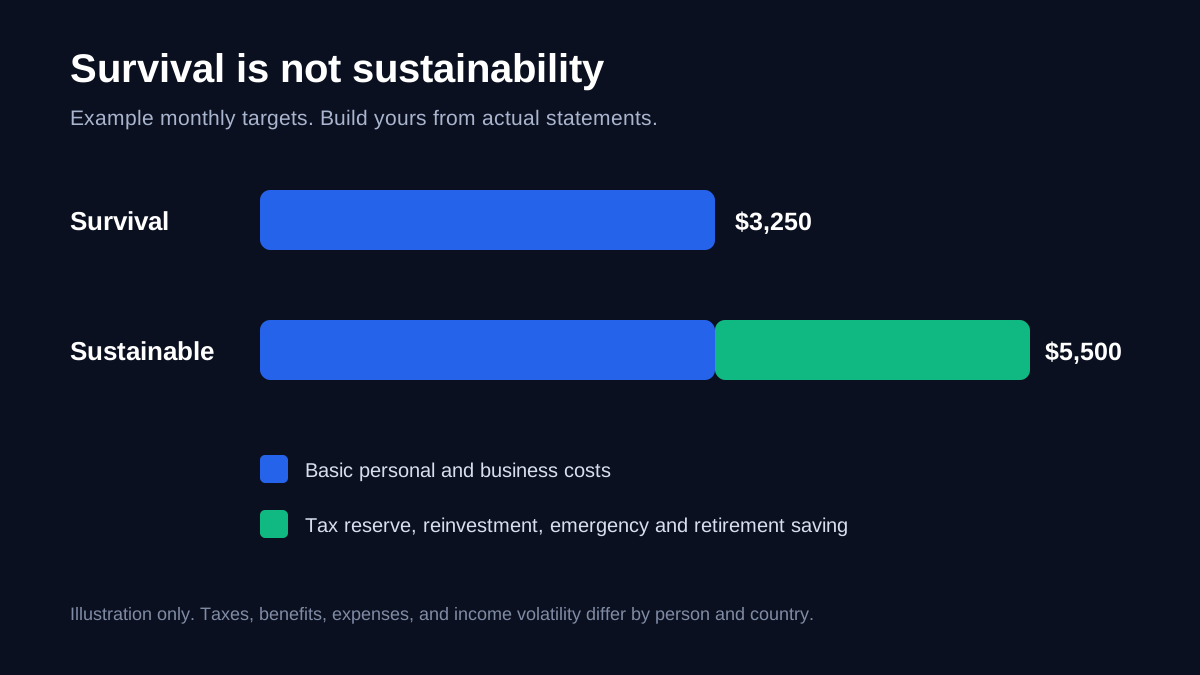
This example is not a national benchmark. Build yours from bank and card statements. Self-employed tax rules vary by country and structure. In the United States, the IRS says self-employment tax generally covers Social Security and Medicare, while income tax is separate. Read the IRS self-employed tax center and ask a qualified accountant about estimated payments.
A useful planning rule is to reserve 25 to 30 percent of profit until a tax professional gives you a better number. That reserve is not spendable income.
Track Three Numbers for Six Months
Before changing employment, track:
- Net music income: cash received minus direct business expenses.
- Monthly growth and volatility: the trend and the distance between strong and weak months.
- Sustainability coverage: net music income divided by the sustainability target.
If music nets $3,300 and your sustainable target is $5,500, coverage is 60 percent. That is progress, not proof you can leave.
Use a rolling six-month average. One festival payment, sync fee, or large session can distort a single month. Track booked future work separately from money already received.
Our music income spreadsheet guide helps build the record, while 21 ways musicians can earn income can expose gaps in your revenue mix.
Build Income Before the Leap
Aim for three active streams that do not fail for the same reason. A practical mix might include:
- Lessons or coaching with recurring weekly demand
- Live work, including original shows, functions, worship, theater, or covers
- Session, production, editing, or mixing work
- Direct fan support, merch, memberships, or ticketed experiences
- Catalog income from royalties, licensing, and sync
- Workshops, notation, sample packs, or educational products
No fixed percentage guarantees safety. As a stress test, ask what happens if your largest stream disappears for three months. If one client, venue, or platform supplies most revenue, build a replacement before resigning.
Example: working guitarist. Teaching brings in $1,200, functions bring $900, sessions average $700, and original music earns $300. Total gross is $3,100. After $500 in direct costs and a tax reserve, the spendable amount is much lower. The artist should compare net income, not announce a $3,100 career.
For deeper planning, read building a music career while working full time and how to quit your day job for music.
Run the Part-Time Test
For two or three months, live as if the job paycheck does not exist. Move the paycheck into a separate runway account. Pay normal expenses only from music income and the amount your transition plan permits.
The test reveals:
- Whether clients pay when expected
- Which months are seasonal
- Whether business expenses were underestimated
- How often you use employment income to rescue music decisions
- Whether your current workload is possible without burning out
Do not skip health insurance, pension contributions, debt, maintenance, or annual bills to make the test pass. Divide yearly costs by 12 and include them.
If the test fails, calculate the exact monthly gap. A $900 gap is a business problem you can solve with six more students, two well-paid shows, a recurring editing client, lower expenses, or a combination. "I need more money" is not a plan. "$900 recurring net income" is.
Calculate Runway Correctly
Runway equals accessible transition savings divided by monthly survival spending. If you have $18,000 and spend $3,000, you have six months.
Do not include retirement accounts, tax reserves, equipment resale estimates, or credit-card limits. Keep an emergency fund separate when possible. Six months is a minimum planning target for many independent workers. Twelve months provides more room for illness, canceled work, delayed invoices, and a slow audience cycle.
The US Consumer Financial Protection Bureau offers an emergency savings guide that explains why even small reserves reduce dependence on debt. Your runway has a related but narrower job: funding a planned transition.
Use a Three-Phase Transition
| Phase | Timing | Evidence to collect | Main actions |
|---|---|---|---|
| Build | Months 1 to 6 | Three streams, monthly books, repeat clients | Keep job, save runway, improve offers |
| Reduce | Months 7 to 12 | Music replaces reduced wages | Cut work hours carefully, protect strong clients |
| Move | Month 12 onward | Six months of consistent coverage | Leave only with runway and a booked pipeline |
Phase 1: Build beside the job
Set regular hours for creative work, paid delivery, sales, marketing, and finance. Build an email list, but do not use a made-up subscriber target as proof of income. A smaller list that buys tickets can be more useful than 5,000 inactive addresses.
Phase 2: Reduce rather than jump
If your employer allows four days, compressed hours, seasonal work, or contract status, test that middle step. Replace the exact lost pay with music before reducing again.
Phase 3: Move on evidence
A sensible trigger is that music covers at least 75 percent of sustainable expenses for six consecutive months, three streams are active, six or more months of runway remain, and confirmed work exists for the next quarter. Adjust for dependents, debt, health, and local protections.
This career planning video covers the operating systems behind a serious 2026 music career. Focus on the routines and business decisions, not promises of quick success.
Prepare for the Schedule Shock
Full-time freedom can remove the structure that made side work productive. Build the week before leaving.
A sample day:
- 9:00 to 12:00: writing, practice, production, or rehearsal
- 13:00 to 15:00: paid client delivery
- 15:00 to 16:30: outreach, content, booking, and sales
- 16:30 to 17:30: invoices, files, learning, and tomorrow's plan
Live work may move the day later. Keep one weekly finance block and one rest day. Track output, not the feeling of being busy.
The transition can bring anxiety, isolation, and identity pressure. Read mental health for working musicians and how to stay motivated in a music career before a crisis appears.
Skills Beyond Playing
You will need sales, negotiation, bookkeeping, contracts, project management, recording literacy, marketing, file management, and professional communication. Learn the bottleneck that prevents paid work now.
Do not buy a course or gear bundle because it feels like progress. Use a real project to identify the missing skill. If clients ask for clean home recordings, improve the recording chain. If inquiries disappear after your quote, improve the offer and follow-up.
You may choose production as the next stream. Moving from performance to music production covers that route. You may also decide a permanent hybrid is healthier. Building a second career alongside music explains that model.
Use a Professional-Readiness Checklist
Before reducing dependable work, answer these questions with documents rather than confidence:
- Do six months of books show net music income and tax reserves?
- Can three active revenue sources survive the loss of the largest client?
- Are six months of survival costs accessible without using tax money or debt?
- Are contracts, invoices, splits, insurance, backups, and registrations organized?
- Does the next 90 days contain confirmed work as well as speculative leads?
- Have you tested paying normal life costs from music for at least two months?
- Is health care arranged after employment benefits end?
- Does the weekly schedule include sales, finance, recovery, and your own catalog?
- Have dependents or partners reviewed the downside plan?
- Is there a clear trigger for returning to part-time employment?
A no does not end the goal. It identifies the next project. If health coverage is missing, price it. If the pipeline is weak, spend eight weeks on recurring offers. If one client supplies most income, build a replacement before resigning.
Set a stop-loss point. For example, if runway falls below four months, booked work drops below half of sustainable expenses, or debt begins funding ordinary costs, start applying for flexible work immediately. Deciding this while calm prevents pride from consuming the final savings.
Frequently Asked Questions
Q: When can I call myself a professional musician?
A: There is no licensing threshold. If you accept payment, meet professional obligations, and operate consistently, the word is reasonable. Do not confuse the label with financial sustainability.
Q: How much should I save before going full time?
A: Calculate your own monthly survival cost. Six months of accessible runway is a practical minimum for many people, while 12 months is safer. Keep taxes and emergencies separate.
Q: Does music need to replace 100 percent of my salary?
A: It needs to cover the life you will actually fund, not match a gross salary mechanically. Employment may include health care, pension, paid leave, equipment, and tax withholding. Price those benefits before comparing.
Q: Is teaching or wedding work selling out?
A: No. Paid service work can fund original music. Decide how many hours it may consume and protect creative blocks. The problem is not the work. It is letting urgent client work erase your own catalog.
Q: What if my income is seasonal?
A: Build the plan around a full year. Save from strong months, track cancellations, and calculate a rolling average. Do not set recurring expenses from your best month.
Q: What if I decide not to quit?
A: A hybrid career can be a deliberate destination. Success can mean stable work, regular releases, meaningful audiences, and low financial panic. Use the career pivot guide to compare options.
Calculate Your Number Tonight
Open the last six months of statements. Write your survival cost, sustainable cost, average net music income, coverage percentage, and months of runway. Choose one recurring revenue gap to close before changing your employment.