Spitfire Audio quietly ended one of the most-loved free tools in music production. On October 31, 2026, LABS and its paid sibling LABS+ were officially sunset: no more new packs, no updates, no bug fixes, no support, and no way to install or redownload content you do not already have.
If LABS was the first orchestral plugin you ever opened, that stings. The good news is that the sounds themselves did not vanish. They moved to Splice's INSTRUMENT plugin, and a wave of genuinely excellent free alternatives has grown up in LABS' shadow. This guide covers exactly what changed, your three realistic paths forward, and where to get the same magic without depending on a plugin that no longer receives support.
What You Will Learn
- What "sunset" actually means for your existing projects
- How LABS went from donationware to a $50 million acquisition to shutdown
- Whether migrating to Splice INSTRUMENT is worth it
- The best free alternatives, from Crow Hill to Decent Sampler to Kontakt Player
- How to protect your sessions from the next plugin sunset
What Actually Happened to LABS
Per Spitfire's own help center, LABS and LABS+ were sunset on October 31, 2026. In plain terms:
- Your installed copy still works. Existing projects load and play LABS as before. Spitfire says it has no desire to break active sessions.
- You can no longer install new packs, repair installs, or redownload content. Whatever is on your drive now is all you will ever have.
- No more updates, fixes, or support. If an OS or DAW update breaks the plugin next year, Spitfire's advice will be to move to Splice INSTRUMENT instead of troubleshooting.
- LABS+ premium content is inaccessible inside LABS. The subscription library now lives only in INSTRUMENT.
- All LABS content moved to Splice INSTRUMENT, under the LABS and Spitfire labels, where new content and development continue.
Two packs cannot be migrated at all: LABS Wurli and LABS Sleigh Bells were already discontinued and cannot be imported into INSTRUMENT. And a LABS+ subscription does not automatically become an INSTRUMENT plan; they are separate services, so subscribers need to work through Spitfire's migration steps or contact support.
How We Got Here
Spitfire Audio was founded in London in 2007 by composers Paul Thomson and Christian Henson, built on ultra-detailed orchestral libraries recorded in rooms like AIR Studios. LABS started as a donationware set of Kontakt instruments, then relaunched in 2018 as a dedicated free plugin, simple interface, gorgeous oddball sounds, regular drops. It became the default answer to "what free plugin should I download first," reaching millions of users and feeding the same ecosystem as Pianobook, the free community sample site Henson founded that year.
Henson left Spitfire in 2023 and later founded The Crow Hill Company, which matters for the alternatives section below. Then in April 2025, Splice acquired Spitfire Audio for a reported $50 million, per the Financial Times via Music Business Worldwide. Paul Thomson stayed on to oversee creative direction.
The writing appeared quickly. In October 2025, Splice launched Splice INSTRUMENT, a cloud-connected plugin with 1,200+ multi-sampled presets built largely on Spitfire recordings, 489 of them free at launch. LABS content was the first range ported over. A year later, the standalone LABS plugin was retired. The strategic read is straightforward: Splice is a subscription company, and a free flagship plugin that generates goodwill but no recurring revenue does not survive a consolidation. The sounds now serve the funnel.
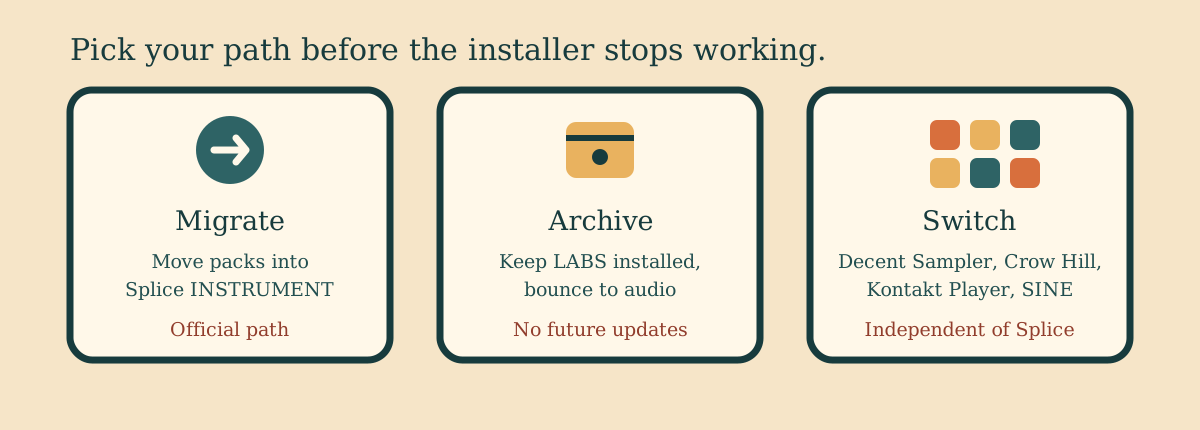
Your Three Options
Option A: Migrate to Splice INSTRUMENT
This is the path Spitfire wants you to take, and for most users it is the sensible default. INSTRUMENT is free to download, its free tier includes the LABS packs you know plus rotating monthly "Free Drops" you keep forever, and the paid INSTRUMENT plan (around $12.99 a month) or Creator/Creator+ subscriptions open the full catalog.
Migration is simple in theory: install INSTRUMENT, link your Spitfire and Splice accounts, and it offers to import your installed LABS packs on first launch. Inside your DAW, nothing changes automatically. Your projects still load the old LABS plugin, so if you want to move a session over, you replace the plugin on each track and load the matching INSTRUMENT preset yourself.
The trade-off is philosophical. INSTRUMENT is a cloud-tethered subscription product. You are trading a free plugin that lived on your drive for a service that lives at a company's discretion, which is exactly the arrangement that just failed you. The sounds are better maintained, but the rug can move again.
Option B: Archive LABS and bounce your tracks
If you just want your old sessions to survive, do two things now:
- Back up the installed LABS content folder and a copy of the plugin installer (the legacy installer is hosted at legacylabs.spitfireaudio.com). After the sunset you cannot repair or redownload packs, so your local copies are the only copies.
- Bounce or freeze every LABS track in your important projects to audio. It costs you MIDI flexibility, but a printed stem cannot be broken by a missing installer five years from now.
This keeps history intact. It does nothing for new music, because the plugin will eventually break under some future macOS or Windows update, which leads to option C.
Option C: Switch to free alternatives
This is where it gets fun. LABS' spirit, characterful instruments made for love rather than margins, is alive and well outside Splice.
The Best Free LABS Alternatives
The Crow Hill Company Vaults. The closest thing to a spiritual successor. Christian Henson, LABS' original champion, now runs Crow Hill, which drops free instruments regularly (recent Vaults include pianos, synths, choirs, and hand percussion) and later moves them into a "From the Vault" tier for a small charity donation, around £3. The recording philosophy is the same: eccentric, characterful, immediate. If you loved LABS for what it was, follow the person who made it.
Decent Sampler plus Pianobook. The biggest free library ecosystem on earth. Pianobook, also founded by Henson in 2018, hosts roughly 2,000 free community-made instruments, and most now run in Decent Sampler, David Hilowitz's free plugin for Windows, Mac, Linux, and iOS. Quality varies wildly, which is the point: felt pianos, broken harmoniums, field-recording textures, hand dryers. It is the weird soul of LABS at ten times the size. The catch is that the community instruments lack LABS' consistent polish and legato depth, so audition before you commit a track to one.
Kontakt Player plus free libraries. The free version of Kontakt opens a huge shelf: Native Instruments' own Komplete Start bundle, ProjectSAM's The Free Orchestra 1 and 2 (trailer-ready ensemble textures), Sonuscore's The Orchestra Elements, and more. If you want one free full-orchestra library, Spitfire's own Symphony Orchestra Discover (free, runs in Kontakt Player, 5.7 GB) is arguably the best orchestral freebie ever released, though it carries the same owner caveat as everything else under the Splice umbrella.
Orchestral Tools: Layers, Berlin Free Orchestra, SINEfactory. Orchestral Tools' free SINE player hosts Layers, a genuinely beautiful one-touch orchestral instrument recorded on Berlin's Teldex stage, plus the Berlin Free Orchestra and the rotating free SINEfactory instruments. For realistic string, brass, and woodwind color, this is the most polished free option that is fully independent of Splice.
Soundpaint. A free instrument engine with a growing catalog of free packs, strong on ambient and hybrid textures. Good LABS-like "instant mood" territory.
The SFZ world: VSCO 2 Community Edition, Sonatina, Virtual Playing Orchestra. Community-built full orchestras in the open SFZ format, played through the free sforzando plugin. Scrappier than commercial libraries, genuinely usable, and impossible for any company to take away since the samples are openly licensed.
Musio. Cinesamples' subscription catalog has a free tier worth a look if you want cinematic instruments on a try-before-subscribing basis.
For pure synthesis needs, free instruments like Vital and Arturia's Analog Lab Play cover the synth side that LABS only dabbled in. And if you eventually go paid, Plugin Boutique's catalog spans everything from Kontakt upgrades to boutique orchestral libraries (our partner link; we earn a commission on purchases).
Quick comparison
| Option | Player | Cost | Best for |
|---|---|---|---|
| Splice INSTRUMENT | INSTRUMENT | Free tier / $12.99/mo | Keeping your actual LABS packs |
| Crow Hill Vaults | Crow Hill plugin | Free / ~£3 charity | The LABS spirit, fresh content |
| Pianobook | Decent Sampler | Free | Weird, characterful textures |
| SSO Discover | Kontakt Player | Free | Full-orchestra realism |
| Komplete Start | Kontakt Player | Free | All-round starter bundle |
| Layers / BFO | SINE Player | Free | Polished orchestral sections |
| The Free Orchestra 1+2 | Kontakt Player | Free | Cinematic and trailer textures |
| Soundpaint | Soundpaint | Free | Ambient, hybrid pads |
| VSCO 2 CE / Sonatina | sforzando (SFZ) | Free | Open-format full orchestras |
Which Alternative Replaces What You Loved in LABS
LABS' trick was that every pack felt like a small gift: a felt piano, a gospel choir, amplified cello, frozen strings. Here is how to rebuild that shelf by use case:
- Soft, character pianos: Crow Hill Vaults pianos and the Pianobook piano collection (hundreds of them, quality varies, gems included).
- String textures and ensembles: Orchestral Tools Layers and BBC SO or SSO Discover.
- Choirs and voices: Crow Hill's choir drops and Soundpaint's vocal packs.
- Oddball and found-sound textures: Pianobook, full stop. A hand dryer bass is exactly the kind of thing LABS would have released.
- Cinematic pads and hits: ProjectSAM's Free Orchestra libraries and Soundpaint.
DixonBeats rounds up the strongest free orchestral plugins and demos how they actually sound in context, including several picks from this list. Watch for how Layers and the free orchestras compare to what you remember LABS sounding like:
A practical note before you install six new libraries: sample instruments eat RAM and disk for breakfast. Our guides on RAM for music production and the best DAWs for 2026 can help you sanity-check your setup, and our free plugins roundup covers the rest of a starter toolkit.
The Bigger Lesson: Do Not Build Sessions on Borrowed Infrastructure
This is the second music-tool shutdown in a month. ToneDen closes on December 1, taking a decade of smart links with it. The pattern is the same: a beloved free tool gets acquired, the acquirer's business model does not include it, and users get a deadline.
You cannot stop companies from sunsetting products, but you can blunt the impact:
- Prefer perpetual licenses over subscriptions for tools your projects depend on. A file you own cannot be revoked.
- Keep local installers and content folders for anything you could not buy again tomorrow.
- Bounce important tracks to audio when a project matters more than its editability.
- Diversify your sound sources so no single account or plugin is a single point of failure.
Frequently Asked Questions
Q: Will LABS stop working in my DAW? A: Not yet. Spitfire says installed copies keep working, including in existing projects, and INSTRUMENT does not replace the old plugin automatically. The risk is long-term: with no updates or support, a future macOS, Windows, or DAW update could break it and there will be no fix. Back up your content folder and bounce critical LABS tracks to audio to be safe.
Q: Is Splice INSTRUMENT free? A: Partially. The plugin is free to download with a Splice account, and the free tier includes hundreds of presets, including the LABS packs, plus rotating monthly Free Drops you keep once claimed. The full catalog requires an INSTRUMENT plan at about $12.99 a month or a Creator/Creator+ subscription. Check Splice's current pricing since plans change.
Q: What happened to my LABS+ subscription? A: LABS+ and Splice INSTRUMENT are separate services, so a LABS+ plan does not automatically grant the same content inside INSTRUMENT. Spitfire's migration guidance says LABS+ subscribers should contact their support team to get moved to an INSTRUMENT plan. Do that before assuming your premium packs survived.
Q: Can I still download LABS packs? A: No. Since October 31, 2026 you cannot install new packs, repair, or redownload existing LABS content. The legacy plugin installer remains at legacylabs.spitfireaudio.com and the plugin still reads installed packs, but the content server for new downloads is off. Your local copies and backups are now the only copies.
Q: What is the best truly free replacement for LABS? A: For the same vibe, Crow Hill's free Vaults drops, run by LABS' original creator Christian Henson. For sheer volume, Decent Sampler plus Pianobook's roughly 2,000 free instruments. For realistic orchestra, Spitfire's own SSO Discover in the free Kontakt Player, or Orchestral Tools' Layers in SINE. All are free with no subscription required.
Q: Do I need Kontakt to use these alternatives? A: Only for Kontakt-format libraries, and the free Kontakt Player covers those (Komplete Start, SSO Discover, ProjectSAM's free orchestras). Decent Sampler, SINE, Soundpaint, sforzando, INSTRUMENT, and Crow Hill are all their own free players, so you can build a full free rig with no Kontakt purchase. Paid Kontakt opens third-party libraries that need the full version, which matters once you start shopping for premium orchestral collections.
Q: Are the LABS sounds in INSTRUMENT identical to the old plugin? A: Spitfire says the LABS packs carry over as the same sampled content under the LABS label, with INSTRUMENT adding its own playback controls like a dynamics layer-blend slider. The interface and preset organization differ, and two discontinued packs (Wurli, Sleigh Bells) did not migrate. Expect the same recordings presented through a different instrument rather than a pixel-perfect recreation.
Start Rebuilding Your Shelf
LABS earned its place in a million template folders, and its retirement is a genuine loss. But between the official migration path in Splice INSTRUMENT, Christian Henson's new work at Crow Hill, and the enormous free ecosystems around Decent Sampler, Kontakt Player, and SINE, you can rebuild a richer free library today than LABS ever offered on its own.
Start with two installs: INSTRUMENT if you want your actual packs back, and Decent Sampler plus an evening on Pianobook if you want the spirit. Then bounce your old LABS tracks to audio and keep making music.
Related reading:
- Best Plugins for Music Production in 2026
- How to Build a Home Studio on Any Budget
- Plugins vs Hardware: What Producers Should Invest In
- How to Set Up a Recording Space in a Small Room
- Best Studio Monitors for Bedroom Producers
Affiliate disclosure: this article contains a partner link to Plugin Boutique. If you buy through it, we may earn a commission at no extra cost to you.


