Choosing a music distributor is one of the first real business decisions independent artists make, and the wrong choice can cost you money, time, or both. DistroKid (7% off), TuneCore, and CD Baby have been the three most widely used starting points for independent artists for over a decade. But in 2025 and 2026, all three made significant changes to their pricing and features that changed how they compare to each other.
This guide cuts through the marketing language and compares them on the things that actually matter: pricing, royalty splits, delivery speed, publishing administration, and which type of artist each one serves best.
Quick-Scan Comparison Table
Here is the side-by-side breakdown so you can compare at a glance. Detailed analysis of each distributor follows below.
| Feature | DistroKid | TuneCore | CD Baby |
|---|---|---|---|
| Base price | $24.99/year | $24.99/year | $9.99/single, $14.99/album (one-time) |
| Royalty split | 100% to artist | 100% to artist | 91% to artist (9% commission) |
| Release limit | Unlimited | Unlimited | Per release (one-time) |
| Delivery speed | 24-72 hours | 24-72 hours | 3-5 business days |
| YouTube Content ID | $4.95/song + 20% revenue cut | Included in higher tiers | Included with paid add-ons |
| Social platform commission (TikTok, YouTube, Instagram, Facebook) | None | 20% on social distribution | 30% on social video monetization |
| Physical distribution | No | No | No (discontinued June 2023) |
| Publishing admin | Add-on ($19.99/year) | TuneCore Publishing (add-on) | CDB Boost ($39.99/release) |
| AI screening | Upload-time classifier, mandatory disclosure | Not currently screening | Not currently screening |
| Best for | High-volume releases, speed | Publishing and international royalties | Permanent distribution without annual fees |
Pricing as of August 2026. Verify current rates at each platform before signing up.
What You Will Learn
- How each distributor actually works and what they charge in 2026
- A side-by-side comparison of all three on key factors
- Which distributor is best depending on your career stage and release volume
- What none of them do, which you still need to handle separately
- How to switch distributors without losing your stream counts
- New competitors entering the space in 2026
How Music Distribution Works
Before comparing the services, it helps to understand what a distributor actually does. When you upload a track, the distributor delivers your audio files, artwork, and metadata to streaming platforms and digital stores on your behalf. They handle the technical requirements each platform has, assign or manage your ISRC codes (which identify individual recordings) and UPC codes (which identify releases), and collect the royalties generated from streams and downloads.
What distributors do not do: collect performance royalties from your PRO (ASCAP, BMI, or SESAC), collect your mechanical royalties unless they offer a publishing admin add-on, or guarantee any specific reach or playlist placements. They are the delivery and accounting layer. Marketing is still your responsibility. For a full breakdown of every royalty type you should be collecting, see our guide on all the music royalties you should be collecting.
You can also read our comprehensive music distribution services comparison for a wider look that includes AWAL, UnitedMasters, RouteNote, and others beyond these three.
DistroKid: Best for High-Volume and Speed
DistroKid (7% off) runs on a flat annual subscription model. You pay a fixed fee per year and can release unlimited music with no per-release charge. The company keeps zero percent of your royalties on standard streaming and download revenue.
Pricing in 2026:
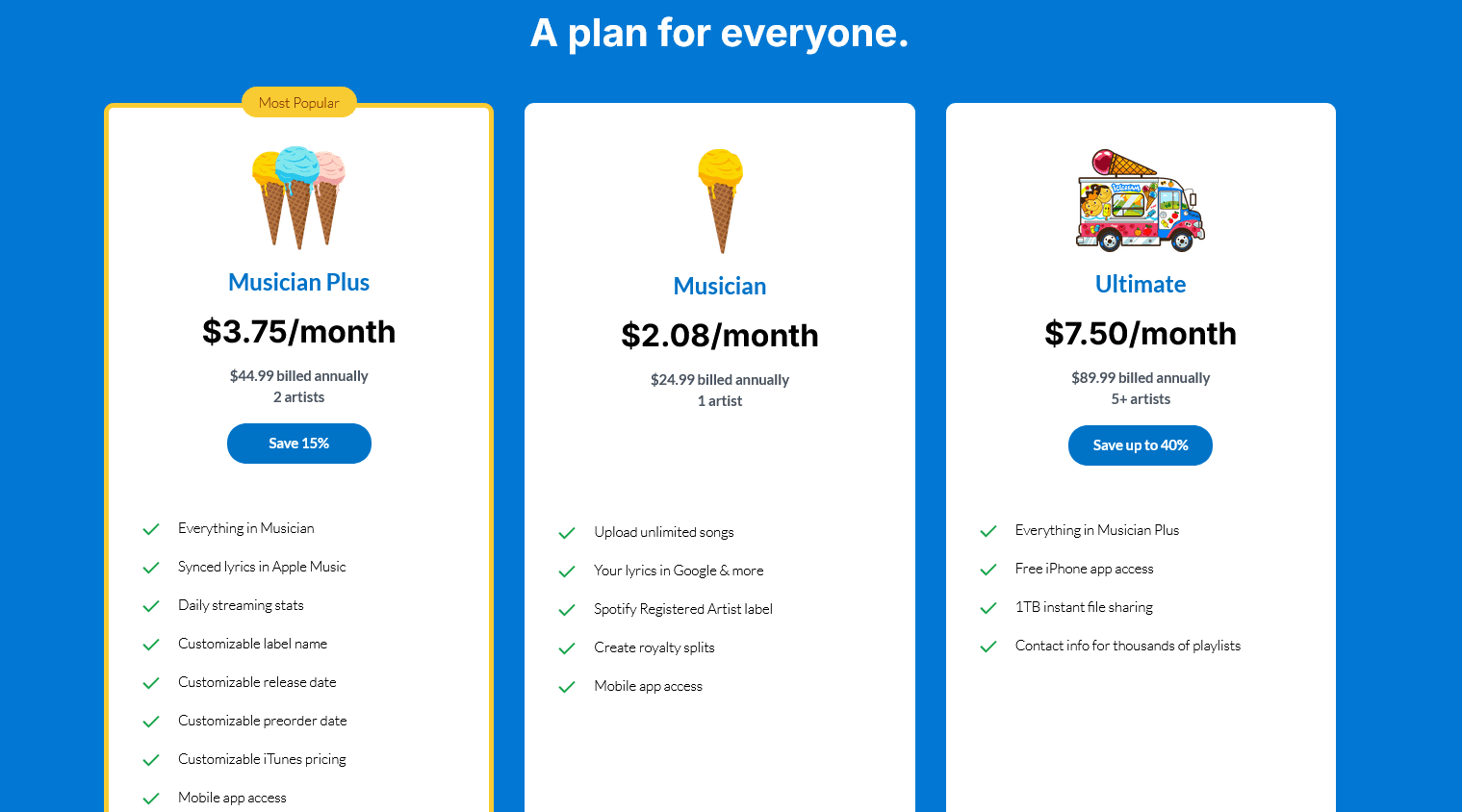
- Musician plan: $24.99 per year (one artist profile, unlimited uploads)
- Musician Plus: $44.99 per year (custom labels, pre-release scheduling, Spotify pre-saves, two artist names)
- Ultimate: $89.99 per year (up to 100 artist profiles, includes Playlister, RIAA Award Monitoring, 1TB file sharing, audio replacement)
- Leave a Legacy: $29 per single or $49 per album (keeps your music live permanently if you cancel)
- YouTube Content ID: $4.95 per song, plus DistroKid takes a 20% cut of Content ID revenue on top of the per-song fee
Royalty split: 100% to you on standard streaming and download revenue. DistroKid takes nothing from those streams. However, YouTube Content ID revenue is split: DistroKid keeps 20% of Content ID earnings in addition to the $4.95 per-song fee. This is an important distinction if YouTube monetization is a significant revenue stream for you.
Delivery speed: The fastest of the three. Releases typically go live within 24 to 72 hours, and some stores go live within hours of upload. For artists doing time-sensitive releases, this matters.
Analytics: Functional but basic. You can see streams and earnings by platform, but the depth is limited compared to dedicated analytics tools. Many artists pair DistroKid with Chartmetric or Soundcharts for deeper data.
AI screening policy: DistroKid now runs an AI classifier at upload time that flags tracks suspected of being AI-generated. Retroactive screening began in March 2025, meaning previously uploaded tracks are also being reviewed. As of May 2026, DistroKid requires mandatory AI disclosure for any tracks created with AI tools. If your track is flagged and you believe it was flagged in error, the appeals process requires you to submit stem files to prove human authorship. This is worth knowing before you upload, especially if you use production tools that incorporate AI-assisted features.
Key limitation: YouTube Content ID costs $4.95 per track plus a 20% revenue cut, which adds up quickly if you release frequently. Customer support is email-based and has a reputation for slow response during busy periods. Publishing admin is available as a paid add-on rather than built in. The AI screening process has also flagged some legitimate tracks, causing delays and frustration for artists who do not use AI generation tools.
Best for: Artists who release music frequently and want the lowest per-release cost over time. If you are releasing twelve or more tracks per year, the math strongly favors DistroKid over any per-release model.
If you want a deeper look at DistroKid specifically, our DistroKid explained guide covers everything from setup to monetization in more detail.
TuneCore: Best for Publishing Administration
TuneCore overhauled its pricing in 2025, moving away from its previous revenue-sharing model and back to flat annual plans with 100% royalty retention. This was a significant improvement for artists who had been paying TuneCore a percentage of their earnings. Note that TuneCore's free tier (social-only distribution) was discontinued in June 2025.
Pricing in 2026:
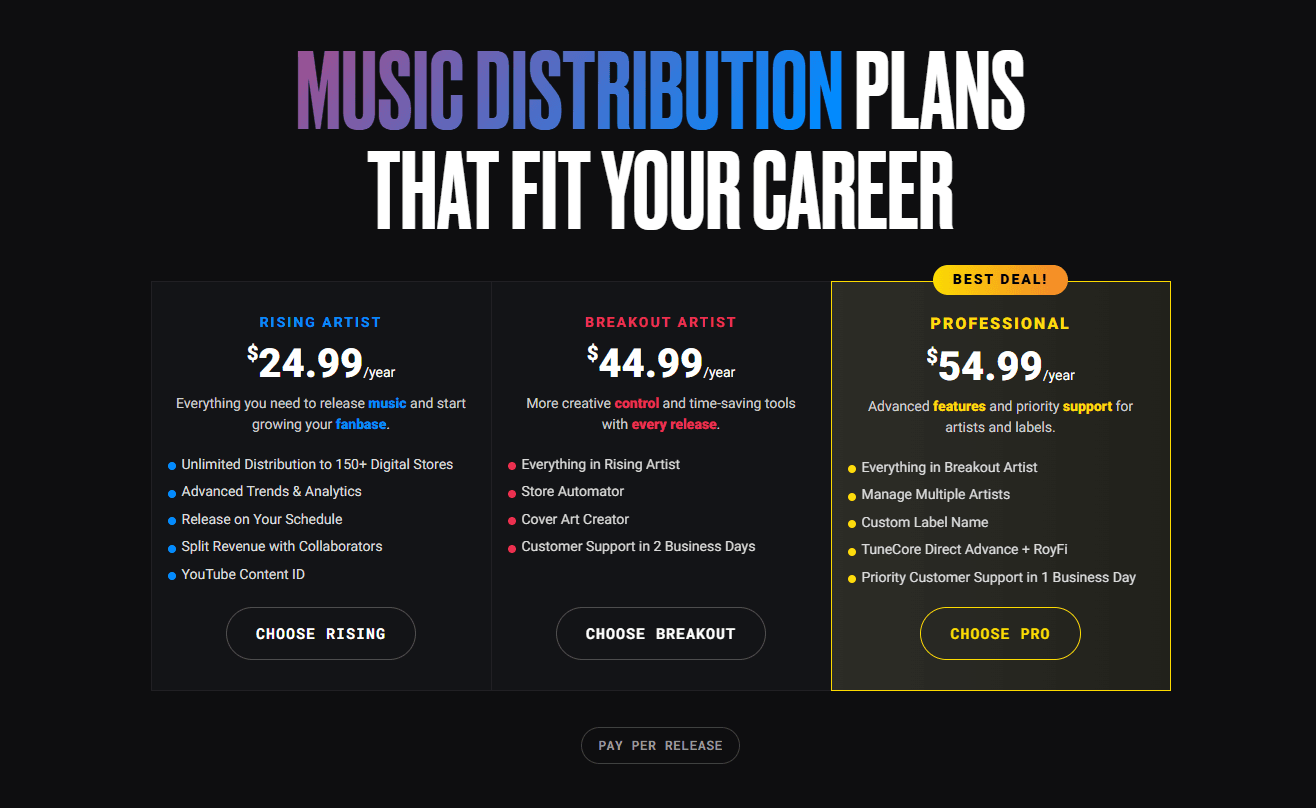
- Rising Artist: $24.99 per year (one artist profile, unlimited releases, royalty splitting)
- Breakout Artist: $44.99 per year (two artist profiles, Store Automator, advanced sales data)
- Professional: $54.99 per year (custom label name, own UPC support, premium reporting, country restrictions)
Royalty split: 100% to you on all paid unlimited plans for standard streaming and download revenue. TuneCore's previous 20% commission model made it expensive for higher-earning artists. That model is now gone on the unlimited subscription tiers.
However, TuneCore does take a 20% commission on social platform revenue. If you distribute to TikTok, YouTube, Instagram, or Facebook through TuneCore, they keep 20% of the royalties generated on those platforms. This is separate from the standard streaming revenue where you keep 100%.
Delivery speed: Comparable to DistroKid for major platforms, typically 24 to 72 hours. Slightly slower for some regional stores.
Publishing administration: TuneCore Publishing is the standout feature that distinguishes it from DistroKid. It collects mechanical royalties, international publishing royalties, and sync income. If you need publishing admin alongside distribution, TuneCore's integrated offering is worth evaluating seriously. Our guide on music publishing explained covers why publishing administration matters for every artist, not just signed acts.
Analytics: Stronger built-in analytics than DistroKid, with territory-level breakdowns and historical trend data. The Professional plan includes premium reporting that approaches dedicated analytics platforms.
Key limitation: The free tier is gone as of June 2025, so there is no longer a no-cost entry point. Publishing admin comes at additional cost beyond the base subscription. The 20% commission on social platform revenue is worth noting if TikTok and Instagram are significant parts of your strategy.
Best for: Artists who want integrated publishing administration, strong international royalty collection, and competitive pricing. With the new unlimited plans priced identically to DistroKid at the entry level, TuneCore is now a genuinely strong alternative rather than just a fallback option.
If you have been looking at alternatives to TuneCore from before its pricing change, our guide on TuneCore alternatives for indie artists is worth revisiting with the new context.
CD Baby: Best for Permanent Distribution Without Annual Fees
CD Baby is the oldest of the three and uses a pay-once-keep-forever model that sets it apart from subscription services. You pay a one-time fee per release, and your music stays live permanently with no annual renewal required. This is the core advantage: you never have to worry about your music disappearing because you stopped paying a subscription.
CD Baby is now owned by Universal Music Group. Virgin Music acquired Downtown Music Holdings (CD Baby's parent company) for $775 million in a deal completed in February 2026, bringing CD Baby under the UMG umbrella. This ownership change is worth knowing because it means CD Baby is now part of the world's largest music company, which could affect future policy decisions and platform relationships.
Pricing in 2026:
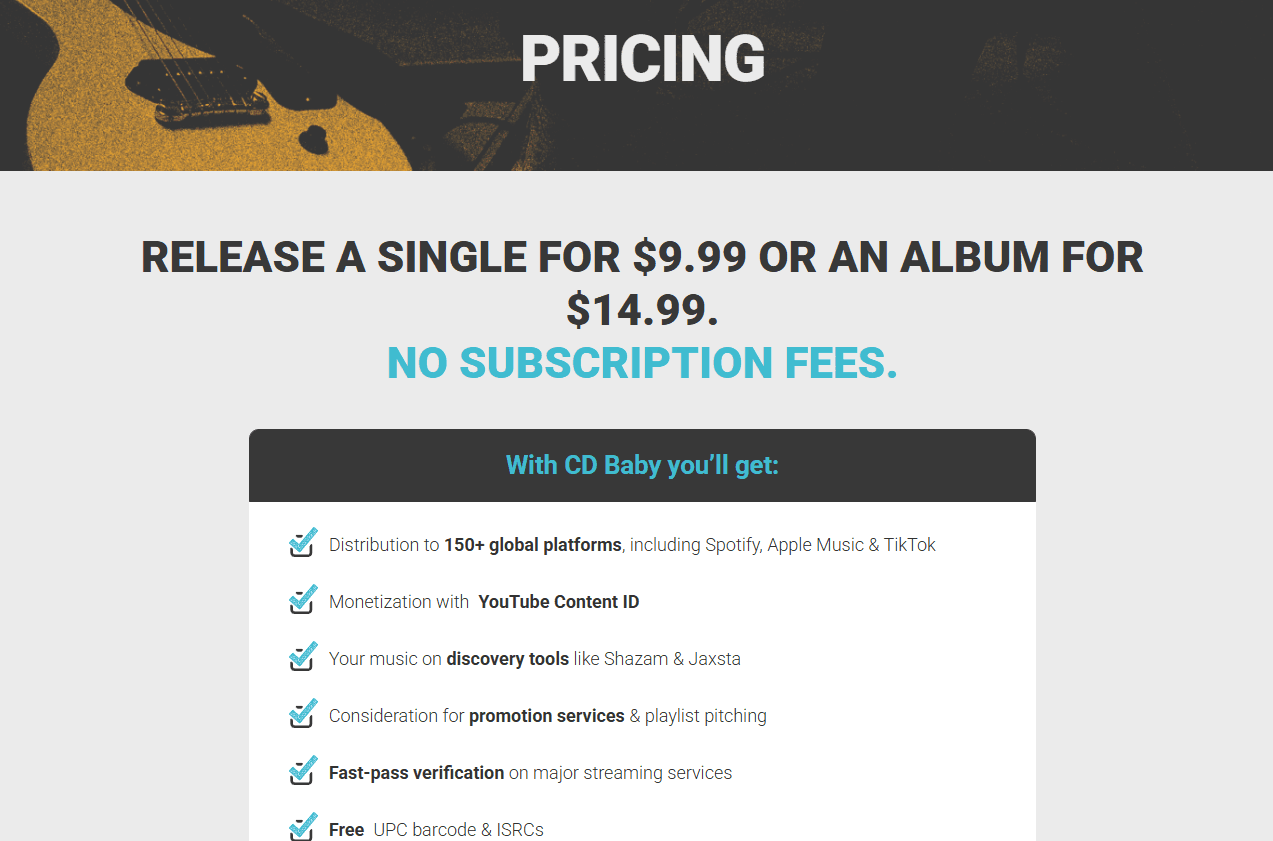
- Standard single: $9.99 (one-time payment)
- Standard album: $14.99 (one-time payment)
- CDB Boost: $39.99 per release (enhanced marketing and promotion tools, sync licensing opportunities)
- No annual renewals required once you have paid the one-time fee
Royalty split and commission breakdown: CD Baby's commission structure is more complex than a single percentage. Here is the full breakdown:
- Digital distribution: CD Baby keeps 9% of digital streaming and download royalties. You keep 91%.
- MLC mechanical royalties: CD Baby keeps 15% of mechanical royalties collected through the MLC on your behalf.
- Social video monetization: CD Baby keeps 30% of revenue from social video platforms (TikTok, YouTube, Instagram, Facebook).
- Sync licensing: CD Baby keeps 40% of sync licensing revenue secured through their sync program.
This tiered commission structure means your effective royalty rate varies significantly depending on where your revenue comes from. An artist earning most of their money from Spotify streams keeps 91%, but an artist earning heavily from sync placements keeps only 60%.
Delivery speed: Slower than the other two, typically three to five business days. A FastForward add-on is available for faster delivery at an additional cost.
Key limitation: The commission structure takes a meaningful bite as your earnings grow, especially from sync and social video sources. CD Baby also retains administrative rights to the ISRCs it assigns for your recordings, which can complicate switching distributors later. If you plan long-term, purchasing your own ISRC blocks is worth considering.
What is no longer available: CD Baby's physical distribution program (CDs and vinyl to brick-and-mortar retailers) was discontinued in June 2023. CD Baby Pro Publishing (the publishing administration service) was discontinued in August 2023 and replaced by CDB Boost at $39.99 per release. If you see older guides referencing physical distribution or Pro Publishing admin through CD Baby, that information is outdated.
Best for: Artists who release infrequently and want lifetime distribution without annual fees. If you release two to three projects per year or less and the one-time cost fits your budget, CD Baby's pay-once model can work out cheaper over time. The permanent hosting is the main draw: your music stays up regardless of whether you keep paying anything.
New Competitors to Consider in 2026
The big three are no longer the only options worth evaluating. Several newer distributors have grown significantly and now offer compelling alternatives depending on your situation.
Stem: Owned by Concord, Stem offers distribution with a focus on revenue advances through their Scale program. If you have existing streaming traction and want an advance against future earnings, Stem is worth a look. Their model is more selective than DistroKid or TuneCore but offers more hands-on financial support.
Amuse: Amuse is no longer free. Their pricing now ranges from $24.99 to $59.99 per year depending on the tier. The platform is mobile-first, which makes it appealing if you prefer managing your releases from a phone. The free tier that made Amuse popular has been discontinued, so do not rely on older reviews that describe it as a no-cost option.
UnitedMasters: UnitedMasters offers two main tiers: DEBUT+ at $19.99 per year and SELECT at $59.99 per year. Their standout feature is brand partnerships: they connect artists with brands for sponsored campaigns and sync opportunities. If you are a hip-hop or R&B artist looking for brand deals alongside distribution, UnitedMasters is a strong option.
SoundOn: SoundOn is TikTok's own distribution service. It is free to use and distributes to 200+ platforms. The key advantage is faster delivery to TikTok and 100% royalties on ByteDance surfaces (TikTok, CapCut, Resso). For DSPs like Spotify and Apple Music, you keep 100% of royalties in year 1 and 90% after that. If TikTok is a central part of your strategy, SoundOn's direct ByteDance integration is a genuine advantage no other distributor can match.
For a broader look at the full distributor landscape, our comprehensive music distribution services comparison covers all of these options and more.
Which to Choose Based on Your Situation
You release music frequently (six or more projects per year): DistroKid (7% off) and its unlimited flat-fee model is almost always the most cost-effective choice. The math is straightforward: at $24.99 per year, each additional release costs you nothing beyond your subscription.
You need publishing administration and international royalty collection: TuneCore. Their publishing admin feature handles the mechanical and international performance royalties that most artists are missing. For an artist who writes their own songs, this can recover more money than the subscription costs.
You release infrequently and want permanent distribution without annual fees: CD Baby's one-time payment model works well if you release one or two projects per year at most. Pay once and move on. Your music stays live permanently.
You are just starting out and testing the waters: DistroKid or TuneCore at the entry level. Both are $24.99 per year with unlimited releases and 100% royalty retention. Either is a reasonable starting point.
You want TikTok-first distribution: SoundOn. Free distribution with 100% royalties on ByteDance surfaces and faster TikTok delivery is hard to beat if TikTok is your primary discovery platform.
For a broader look at why the free distribution model largely disappeared from the industry, our post on why music distributors no longer offer free distribution explains the economics behind these pricing models.
What None of These Distributors Do
A common misconception is that a distributor handles your entire royalty situation. They do not. Here is what you still need to arrange separately, regardless of which distributor you choose:
- Performance royalties: Register with ASCAP, BMI, or SESAC for your compositions
- Mechanical royalties: Register with the MLC (Mechanical Licensing Collective) for US mechanical royalties from interactive streaming
- SoundExchange: Register for digital performance royalties from non-interactive streaming like satellite radio and Pandora
- International performance royalties: A publishing administrator like Songtrust collects these from CMOs in 200+ countries
Your distributor collects your share of streaming revenue from the master recording. The composition royalties and performance royalties are separate streams that require separate registration.
To calculate what your music is earning and model what growth could produce, use our streaming royalty calculator.
How to Switch Distributors Without Losing Streams
You can switch distributors at any point, but there are things to know before you do. When you move a release to a new distributor, your stream counts on platforms like Spotify reset unless you use the same ISRC codes. Using the same ISRCs is the key to preserving your historical stream data when switching.
If your ISRCs were assigned by your current distributor and you do not own them separately, transferring them may require extra steps or may not be possible in all cases. This is the main practical reason to own your ISRCs from the start, particularly if you plan to switch distributors as your career evolves.
For guidance on the full release process and what to prepare before distributing, see our step-by-step guide to releasing music independently.
Frequently Asked Questions
Q: Is DistroKid worth it if I only release one or two songs per year? At two releases per year, DistroKid at $24.99 costs $12.50 per release, which is comparable to CD Baby's one-time rate minus the royalty cut. If you plan to release more in future years, the subscription model typically wins. If you release one song every two years, CD Baby's one-time model may actually cost less over time.
Q: Does it matter which distributor I choose for getting on Spotify playlists? No. Playlist placement is based on your music and pitch, not your distributor. All three services deliver to Spotify and support editorial pitching through Spotify for Artists.
Q: Can I use more than one distributor at the same time? Yes, for different releases. Some artists use DistroKid for regular singles and CD Baby for specific projects where they want permanent hosting. The main requirement is that you do not submit the same release to multiple distributors simultaneously, which can create conflicts in the stores.
Q: What happened to TuneCore's free tier? TuneCore discontinued its free social-only distribution tier in June 2025. All TuneCore plans now require a paid subscription, starting at $24.99 per year for the Rising Artist plan.
Q: What happened to CD Baby Pro Publishing? CD Baby Pro Publishing was discontinued in August 2023. It has been replaced by CDB Boost, which costs $39.99 per release and includes enhanced marketing tools and sync licensing opportunities. The old Pro Publishing admin service is no longer available.
Q: Does the distributor I choose affect my streaming royalty rates? No. Your per-stream rates on Spotify, Apple Music, and other platforms are determined by those platforms, not your distributor. See our breakdown of Spotify vs Apple Music pay rates in 2026 for current rate comparisons.
Q: Does DistroKid screen for AI-generated music? Yes. DistroKid runs an AI classifier at upload time, began retroactive screening in March 2025, and requires mandatory AI disclosure as of May 2026. If your track is flagged, you can appeal by submitting stem files to prove human authorship.
Choosing Based on What You Need
There is no universally best distributor. There is only the one that fits your current career stage and release volume.
DistroKid (7% off) wins on volume and speed. TuneCore wins on publishing administration and analytics. CD Baby wins on lifetime costs for infrequent releases and permanent hosting without annual fees.
Make the choice based on how often you release, whether you need publishing admin, and how you think your release cadence will evolve over the next two or three years. And understand what the distributor does not do so you can fill those gaps separately.
For a look at how your choice of distributor interacts with your royalty collection across all streams, our guide on all the royalties you should be collecting covers the full picture. And to understand the difference between an aggregator and a distributor, which often comes up in industry conversations, our post on music aggregators vs distributors clears up the terminology.
External references: DistroKid pricing page, TuneCore pricing page, CD Baby pricing page, MLC registration.


